A glimpse of the Future
There is good evidence that the next cyclical advance of Pleistocene ice will occur within the next thousand years or so. This will be a catastrophe for humanity, but I am optimistic enough to suppose that, as a species, we will survive. Our few remaining short-lived descendants, as they shiver before a fire at the mouth of their cave after a long day’s hunting in the snow, will tell each other stories of a legendary past when their long-lived ancestors enjoyed a life of abundance in a former golden age – the Happy Holocene.
Meanwhile, back in the Holocene.
Our civilisation is so efficient that more than 60% of its 8.24 billion citizens are free to pursue fields of skill and knowledge that have nothing directly to do with food production. In developed, industrialised nations that percentage must be nearer 90%.
One of these fields of knowledge is geology.
The International Union of Geological Sciences (IUGS), founded in 1961, is the peak governing body of geology. Under its aegis are a number of Commissions covering such things as Structure and Tectonics, Geochemistry, Ethics, History of Geology, Geological Education and so on. The oldest and probably the most important of these Commissions is the International Commission on Stratigraphy (ICS) which is tasked with responsibility for the subdivision of geological time going back 4.6 billion years (4.6 Ga).
The subdivisions are based on the stratigraphic record – the sequential accumulation of sediments and the fossil remains (if any) within them. Boundaries between subdivisions are based on significant continental or world-wide, geologically rapid, transitions in the overall depositional environment. Localities where these key transitions are well exposed are referenced as type-localities and dated by isotopic methods. Each distinctive rock/fossil assemblage (subdivision) is given a name, thus reifying it a “thing”. Many of the names go back more than 200 years and reflect the happenstance of early geological research (see my previous post, The Invention of the Paleozoic). On a stratigraphic chart, subdivisions are organised by nested hierarchies of ever smaller intervals of time. Each step of the classification scheme is given a formal name. Eons (sometimes called Eonthems) are the longest: there are four of these in the 4.6 Ga geological record. Together, these four Eons are subdivided into fifteen Eras (Erathems), and these fifteen Eras together contain twenty-six Periods (Systems). The Periods contain 38 Epochs (Series), and the Epochs themselves contain over a 100 Stages (Ages). A Stage is the shortest time interval in the classification.
If we consider the stratigraphic chart as a Library of Time, then the Eons are books, the Eras chapters, the Periods paragraphs, the Epochs sentences, and the Stages, words. The last words of the last sentence of the last paragraph of the last chapter of the last book in the library are: “to be continued…”
The most recent subdivisions of the stratigraphic column are the subject of this post.
To carry out their task, the ICS created a number of Sub Commissions, each responsible for one of the 26 Periods in the stratigraphic record. The most recent Period, the one we live in today, is known as the Quaternary and began 2.58 million years (2.58 Ma) ago. According to the ICS Sub Commission for the Quaternary (SQS), the Quaternary is made up of two Epochs: the Pleistocene from 2.58 Ma to o.0117 Ma, and the Holocene from 0.0117 Ma to present.
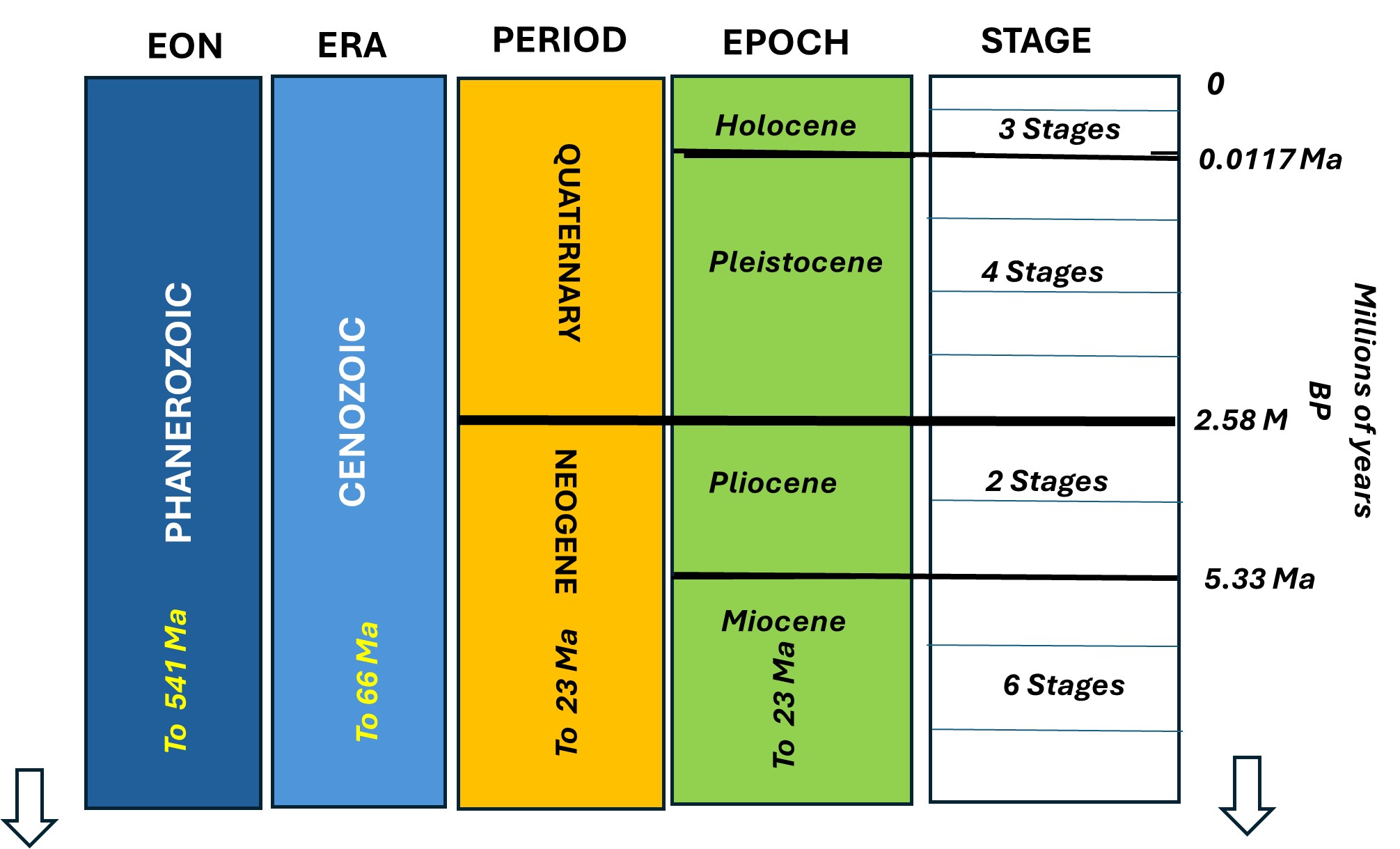
Geological subdivisions of the recent past, according to the ICS. Redrawn from their official chart at. Click for a larger image.

Graph A: Global temperatures over the past 65 Ma (the Cenozoic Era). The Pleistocene Epoch (Ice Age) and the Quaternary Period begin at 2.6 Ma on the right of the graph.
The lower boundary of the Pleistocene Epoch of the Quaternary Period is defined by the start of an Ice Age when temperatures plummeted, and kilometer-thick ice became generally established over land and sea at high- to mid-latitude areas around both poles. These extreme conditions are known as Glacial.
The end of the Pleistocene should therefore be when glacial conditions cease for a significant period of time (i.e. tens of thousands of years). That has not happened yet. Considering the duration of previous Ice Ages, each of which lasted tens of millions of years (such as the one at the end of the Ordovician Era around 440 Ma, or that near the end of the Permian Era around 250 Ma), the Pleistocene Ice Age probably many millions of years to run (see my post, Climate Change Explained in Three Graphs). Nor are the general icy conditions of the Pleistocene ameliorating with the passage of time. The opposite is true. Glacial advances in the latter half of the Pleistocene have been longer, colder and more extensive than those of the earlier part of the Epoch. This change to longer cycles and colder temperatures has been referred to as the Mid-Pliestocene Transition.
We live in the Holocene, a time of ice retreat, relatively warm temperature and sea level rise. Pleistocene geological records show at least 45 such temporary retreats of ice. These are called Interglacials and they make up approximately 20% of Pleistocene time (the exact number of Interglacials depends on how their start and end dates are defined). Holocene conditions are not significantly different (at least, so far) from any of the previous Interglacials.
But, according to the ICS, and with the approval of the IUGS, the Pleistocene Epoch (or Pleistocene Ice Age) finished, terminated and collapsed forever 11,700 years ago (0.0117 Ma), to be replaced by the Holocene Epoch. These august bodies must therefore consider that the Holocene warm episode is fundamentally different from the numerous interglacials that preceded it. There is no evidence for this.
Conversely, if the Holocene is a separate Epoch within the Quaternary, then, logically, all the previous Interglacials and Glacials of the Quaternary must be judged as Epochs also. With around 90 Epochs, the Quaternary would then contain more than three times as many Epochs as all other Periods of the stratigraphic record combined – and the Quaternary is not finished yet. An absurd proposition.
In this dilemma, the ICS appears to be trapped in an epistemological maze with no clear roadmap to follow.
Could the ICS be correct in concluding that the Pleistocene Ice Age ended around 12,000 years ago? It will be another 12,000 years before we can be 100% certain of the answer to that question. But I don’t think we need to wait that long. Based on the evidence available now, I am more than 90% certain that the glaciers will return.
Here is the most compelling of that evidence…
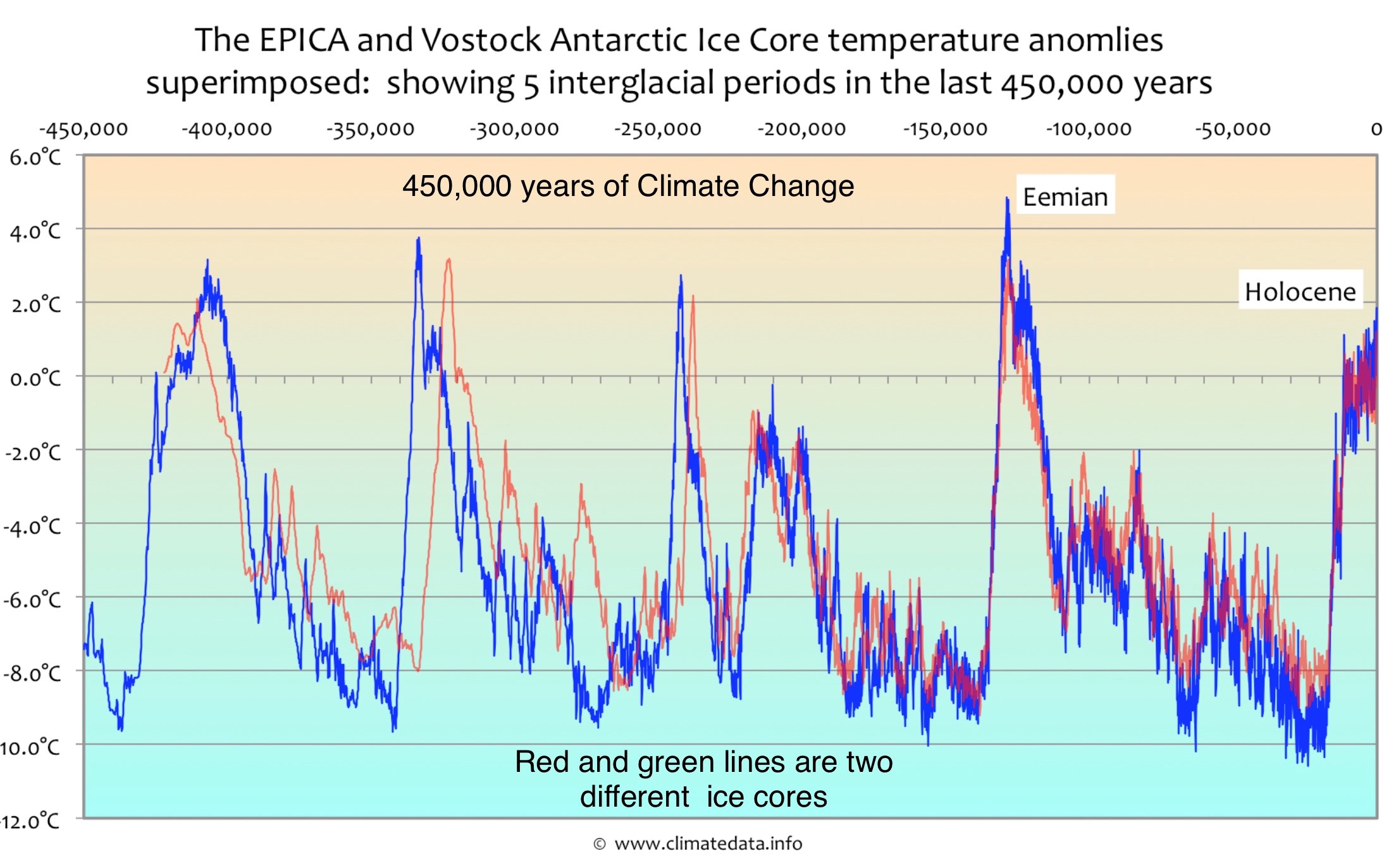
Graph B: Antarctic ice core data from www.climatedata.info Click for a larger image
The graph above shows changes in air temperature (blue) and CO2 concentration (red) over Antarctica, as measured in the Vostok and EPICA ice cores. Broadly similar graphs can be produced for other regions of the globe. The graph begins (at left) 450,000 years ago (0.45 Ma) and continues to present day. This represents the last 20% of the Pleistocene. Five upward spikes in the graph are apparent: these are Interglacial episodes of ice retreat – the last two labeled as “Eemian” and “Holocene”.
There is another important takeaway from this graph: there is good correlation between temperature and CO2, but the peaks and troughs of CO2 lag the peaks and troughs of temperature by 500-1000 years. This tells us that whereas temperature might credibly be controlling CO2, CO2 cannot be controlling temperature (since an effect cannot precede its cause).
During the Eemian, elephant and hippopotami gamboled on the mud flats of the River Thames. When temperatures plummeted, these species migrated south but 120,000 years later, another species of large out-of-Africa mammal gambol once again on the banks the Thames.
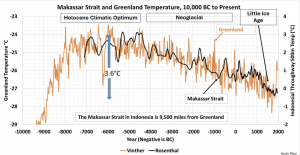
Graph C: Greenland ice core data from Vinther et al 2009: https://www.nature.com/articles/nature08355. Macassar Strait benthic sediment data from Rosenthal et al 2013 http://science.sciencemag.org/content/342/6158/617. Compilation of the two data sets by Andy May Click for a larger image
The graph above shows air and sea temperatures over the past 10,000 years – the last 85% of the Holocene. These are compiled from ice core data from Greenland (orange line) and sea-floor sediment data from the Eastern Pacific (black line). The good correlation of temperatures between two regions on opposite sides of the globe, based 0n two completely different types of deposit, is compelling.
Other graphs of Holocene temperatures are available. They use different proxy methods from different locations around the world. As one might expect, these differ in detail, but they all show a similar pattern to graph B. (see Nature Science Data, 2020 HERE).
From the graph we can see a steep initial rise in Holocene temperature to a maximum around 6-9000 years before present (BP). This is known as the Holocene Climate Optimum during which relict glaciers in mountain areas around the world all but disappeared. The HCO was followed by a slow and gradual decline to the Neoglacial conditions of the Little Ice Age, 200 to 800 years BP.
Comparing graphs B and C (allowing for their different vertical scales), all the interglacials of the Pleistocene for which we have sufficient resolution show a similar strongly skewed pattern – a steep rise to a plateau, followed by a long slow fall to glacial or neoglacial conditions. The relentless decline in global temperature following the long Holocene Climate Optimum matches this pattern and is an ominous pointer to the next cyclical glacial advance.
The extreme right of the Greenland ice-core data (graph C) shows an upward trend in temperature of 1-1.5C beginning around 100-150 years ago. This is the called the Modern Warm Period - the subject of much current existential angst from many scientists who should know better (see my previous post HERE). But modern global temperature is only warm when compared against the anomalous low temperature of the preceding neoglacial. Compared to temperatures that were common for the majority of the Holocene, we are living today in relatively cool conditions. And the saw-tooth nature of the graph shows that sharp increases and decreases in global temperature over relatively short time frames has been a common pattern throughout the Holocene. (Note that the visual impact of short-term fluctuations such as these can be dampened or exaggerated on a graph by choice of vertical scale).
The members of the ICS apparently consider that, starting from the time of the cultural Neolithic Revolution (made possible by the warmth of the early Holocene), humans have caused sufficiently large changes to global sedimentary processes to justify raising the status of the Holocene from merely the most recent of the many Pleistocene interglacials, to a unique stratigraphic Epoch in its own right.
Or, do they regard the fact that we live within it sufficient justification for awarding the Holocene a special geological status?
Whatever the reasoning of the ICS, this is a controversial and debatable proposition. As the late, great, Carl Sagan wrote in 1979: “Extraordinary claims require extraordinary evidence”.
Astonishingly, in 2019, the ICS made another proposal to their governing body, the IUGS. They advocated the creation of a brand-new Epoch to succeed the Holocene Epoch. This Epoch was to be called the “Anthropocene”, a neologism cobbled together from two Greek words meaning roughly: “The New Age of Man”. The new Epoch was supposed to have started around 1950AD.
This is equivalent to a declaration made in 1946 that the establishment of the United Nations would lead to a new epoch of Global Stability and Peace (Pax Americana?) that will last for 1,000 years.
In 2017, the IUGS ratified the ICS proposal to upgrade the Holocene to the status of an Epoch. In 2019, to their credit, the IUGS rejected the ICS Anthropocene proposal in a near unanimous vote.
I strongly suspect that the stratigraphic proposals of the ICS concerning the Holocene and Anthropocene were influenced by the current scientific conceit that the effects of modern human activities are strong enough to overwhelm all other natural earth forces that have controlled sedimentary deposition around the globe for billions of years.
Our remote descendants, as they shiver in their caves, may well think otherwise.