There is No Wisdom in Crowds
The present system of science publishing is broken. Abuse and fraud are common and increasing. Ways of overcoming this are suggested.
*************
In 2023, the New Scientist Magazine reported that chemist Jose Manual Lorenzo, an Associate Professor at a regional Spanish university, had, along with multiple co-authors, published 176 scientific papers in 2022 – a rate of one paper every two days. Assuming that Lorenzo had other things to do with his time apart from research and authorship (eating, sleeping, supervising, lecturing, administration, following the football etc..) it would be a miracle if he had had time to read these papers, let alone make any meaningful input to their content.
Professor Lorenzo is one of a new breed of what are called hyper-profile authors.
How has science publishing come to this?
Over more than 500 years, scientific discoveries that revolutionised our knowledge of the world have been announced in books or Scientific Journals by single, or at the most, by two authors. To name but a few (my personal choice): the theory of evolution of species through natural selection by Charles Darwin and Alfred Russel Wallace in 1856 [1], the grand unification of electricity and magnetism (electromagnetism) by James Clerk Maxwell in 1865 [2], the Special and General Theories of Relativity by Albert Einstein in 1905 [3] and 1916, the discovery by Edwin Hubble in1929[4] that billions of galaxies exist beyond our Milky Way, the theory of Alfred Wegener in 1912, that whole continents can move across the face of the earth [5], and the resolution of the helical molecular structure of DNA by Francis Crick and James Watson in 1953 [6].
But since the end of WW2, single or even double author papers have become rare. Few today have less than 5. A paper (on fruit flies) was published in 2015 in the Journal Genes, Genomes, Genetics with 1014 authors – included in this paper as “authors” were the many hundreds of conscripted undergraduate students who had helped collect the field data [7]. But in the same year, the entomologists were beaten into the Guinness Book of Records by the particle physicists who published, in the journal Physics Review, a paper with 5,152 authors [8]. The paper is 33 pages long, the first 24 of which are taken up by the alphabetic author list. This is taking consensus and inclusion to absurd lengths. In the case of the physicists, the totality of staff in large cooperating government research groups, from several countries, from lowest technician to Heads of Departments, were signed up. (Did no one have a dissenting voice?).
In all these cases each “author” presumably got to add the publication and any citation credits to his or her personal CV.
It is as if in 1859 Charles Darwin, publishing his revolutionary book On the Origin of Species, had included as co-authors T. H. Huxley, C. Lyell, J. D. Hooker, A. R. Wallace, A. Gray, Captain R. Fitzroy and the entire crew of HMS Beagle, including the ship’s cat!
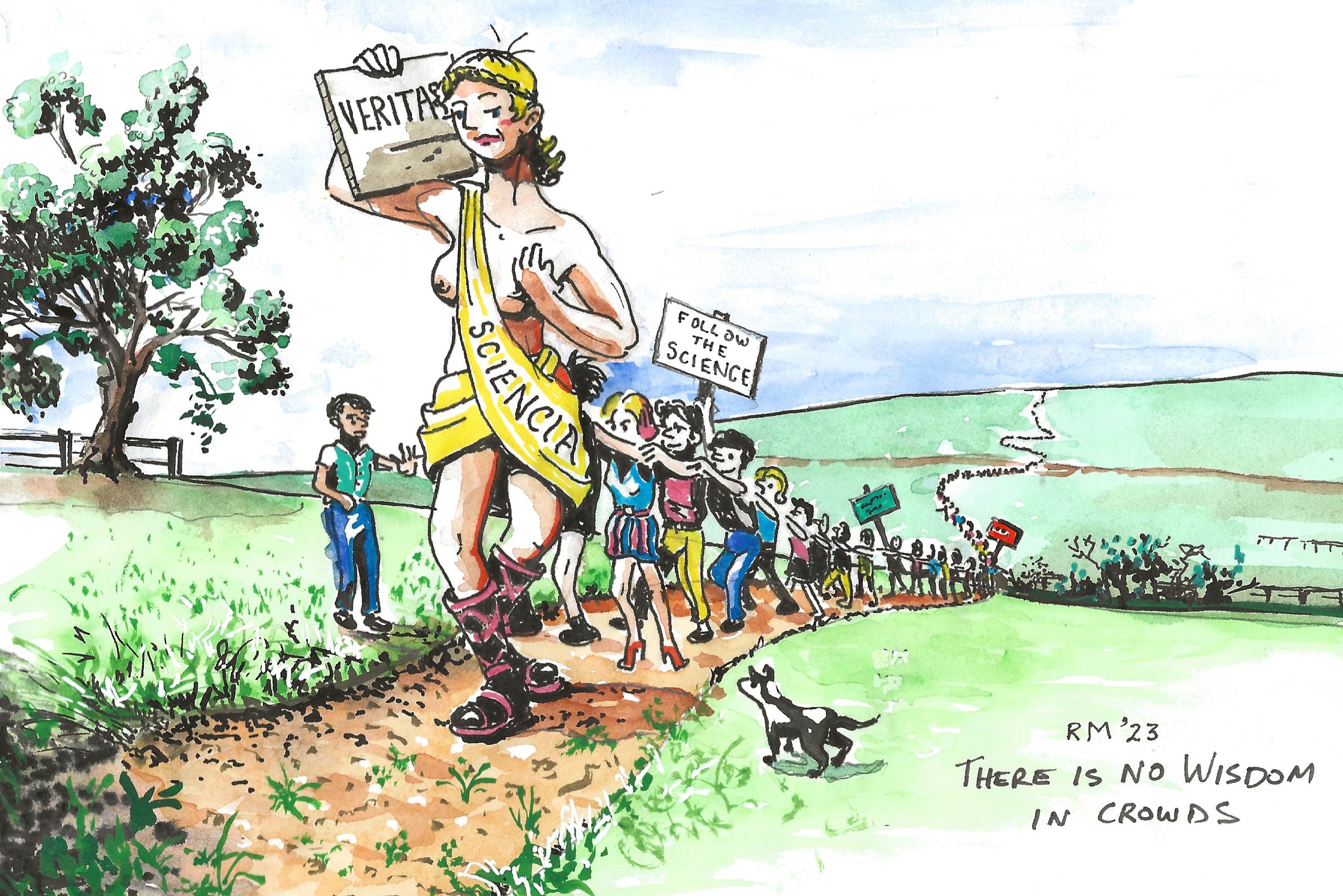 There is no wisdom in crowds
Traditionally, the role of minor or peripheral contributors to a scientific paper were dealt with by including them in a brief “Acknowledgements” section in the main text. But listing such contributors as authors destroys the accepted meaning of that word. A new term - hyper-authorship - has been coined to cover this recent publishing phenomenon, while authors with huge publication lists (such as Professor Lorenzo at the head of this post) are called hyper-profile authors. From this point on, I will refer to such people as hyper-profile authors or bracket them in quotation marks as “authors”.
A 2025 publication in the Journal of Informetrics [9] shows that the academic disciplines most guilty of hyper-authorship are (in order) Clinical Medicine, Engineering, Biology and the Political & Social Sciences. The fields most immune to the phenomenon (relatively) are Mathematics, Chemistry, Psychology and Economics.
For academics, their institutions and the journals they publish in, status and reputation come from:
1. The total number of papers or books you “author” (the famous “publish or perish” dictum),
2. The prestige of the Journals in which you publish. Today there are over 40,000 technical journals: Nature and Science are the big dogs at the top of the tree who routinely reject more than 9 out of 10 of scientific papers submitted to them (but see footnote 12). At the bottom of the pecking order are journals that will publish anything, so long as you pay their fee. These latter are known as predatory journals [10], they are also sometimes referred to as paper mills.
3. The number of references that your paper garners. Such published references are called citations. It does not matter whether the citations praise or damn your work, a citation is a citation: your paper is being read.
4. The position of your university in annual global ranking tables. There are around 30,000 self-described “universities” in the world (internet search) but ranking tables, such as the annual TES (Times Educational Supplement) Rankings consider less than one tenth of these as worthy of inclusion in their surveys. Oxford, MIT (Massachusetts Institute of Technology), Princeton, Cambridge and Harvard are the top five in this table for 2025, but just being included in the top 200 is a proud boast. These tables are compiled on the basis of the number of publications and citations garnered by the research employees of each university. A high ranking is vitally important to universities as it determines the number of students they attract, the fees they can charge and the amount of grant money and endowments they are able to hoover up.
Points 2, 3 and 4 were designed to provide controls on abuses of point 1, ensuring that mere quantity does not overwhelm quality.
But the incentives on all parties to rig the system in their favour are high, and the ways of gaming the system are many…
Let me count the ways…
1. Join an informal “publishing network” made up of researchers with similar interests across several institutions and continents – the more the better. Wide discussions and sharing of ideas are undoubtedly a good thing [11], but one of these “similar interests” will certainly be: “include me as a co-author in your papers and I will you include as one in mine”. Scratch my back and I’ll scratch yours.
2. If your publishing network is large, then it is likely that editors, struggling to find willing reviewers of your paper with appropriate knowledge (peer reviewing is a time consuming, voluntary service), will seek them from among your network – people who might be your friends, colleagues or have previously co-authored with you. This is not peer review, it’s pal-review.
3. Break your long and comprehensive papers into discrete portions and publish each portion separately (a technique more suitable to some research fields than others). Otherwise known as Salami-slicing.
4. Pay to publish in predatory journals with lax or non-existent review processes (see footnote 10). Pay to publish.
5. Media statements by you or your institution about published or pending research results are a good way of short circuiting the normal science assessment process and making direct emotional appeal to the public and to government funding bodies. Therefore, in press releases on your latest results use only hyped-up language, emphasize the positive and hide any qualifications, uncertainties or alternate explanations you might have. Science by Press Release.
6. Make sure each paper you “author” includes as many references to your own publications as possible – and make sure your “co-authors” do the same. Self-promotion.
7. Confirmation bias hinders objective appraisal. Papers that confirm existing widespread theory will always gather more citations than those that challenge it. Therefore, if you want to get past peer reviewers and attract maximum citations, do not introduce new ideas that challenge orthodoxy, or, if you do, hedge them about with obsequious qualifications and apologies or bury them so deep in the text, appendixes or supplementary data that they might not be noticed. Confirmation Bias [12].
8. If you are a peer reviewer for a journal submission, make your favourable review conditional on the submitting “authors” making references to your own papers. Intellectual blackmail.
9. As a corollary to point 8, if you know, suspect or guess (in many cases, easy to do) who the supposedly anonymous reviewers of your journal submission will be, then load your paper with favourable references to their papers. Flattery.
10. If you are an editor of a journal making annual editorial reviews (a requirement of many publishing companies), then add multiple references your own papers in that journal (for an egregious example of this, see footnote [13]). This will not only increase your own citation index, but that of the journal as well. Corruption.
11. If your research is not producing positive results, or results that do not support your pre-conceived ideas, or you just want an easy way to increase your publication and citation indexes, simply invent or falsify your data. This is deliberate fraud, but it can be very difficult to prove. With around half a million scientific papers published each year, many hundreds of examples of fraud have been exposed. But those are probably just the tip of an iceberg (see footnote 10 and references in the Stuart Ritchie book mentioned in Acknowledgements). Fraud.
The Problem
There are far, far more PhDs awarded today than there are career academic employment positions. The stratagems I list above loom large in the competitive world of young researchers who wish to gain a foothold in academia. Once they have garnered, by whatever means, sufficient publications and citation credits then tenure (a job for life) awaits, and they can afford to relax: the Mathew Effect will do the rest. Success breeds success.
“For unto everyone that hath, shall be given: and he shall have abundance. But from him that hath not, even that which he hath, shall be taken away” Mathew Gospel, 25:29
Hyper-authorship, pal review, salami slicing, pay-to-publish, confirmation bias, back scratching, science by press release, self-promotion, intellectual blackmail, flattery, corruption and fraud are well known problems and have been outlined in numerous books, papers, op-eds, blogs and podcasts over many years. But the malign influence of these stratagems has not gone away. There is evidence that it is getting worse. A detailed 2025 review on this subject in the prestigious Proceedings of the National Academy of Science [14] warns that “the publication of fraudulent science is outpacing the growth rate of legitimate scientific publications”. This is happening because academia, by and large, assesses and rewards researchers on an easily gamed set of criteria. A natural selection process has evolved that rewards the dishonest practices enumerated above. This creates a “survival of the fittest” environment in which honest researchers risk extinction if they do not compete on similar terms.
The science publishing system that has grown up over the last 50-100 years (peer review, publication and citation indexes, exaggerated benefits for established elites) is broken and is totally inadequate for today’s environment of globalisation and digital publishing. A drastic overhaul is urgently needed.
Some suggested solutions:
All research results, whether positive or negative, should be published online: free, searchable and available to all. Scientific wisdom is not the exclusive preserve of academia.
Peer review should be retained but with no anonymity. All correspondence between peer reviewers and editors with the author(s) – good reviews as well as bad – should be published along with the paper [15].
Papers with more than one author must include a written statement detailing the intellectual contribution to the paper of each listed author.
Official press releases must adhere to the same standards of language, restraint and caution as are applied to scientific papers.
A supplementary section providing all data and computer code on which the conclusions of the paper are based, as well as full details of experimental methods employed so that others can replicate your work, should be an absolute requirement for acceptance by all journals.
A link to a section where any subsequent citations can be listed must accompany each paper. The list will include the names of the citation author(s) and their context.
Replication papers, when or if they become available, should be published on the same web page as the original paper, whether they falsify (and thus disprove) your thesis or not.
Links to all other sections of the paper as detailed here must be given in the main text.
With each paper, an open discussion forum should be provided where anyone (including the authors) can propose corrections, respond to criticism, offer comments or provide additional data and alternative hypotheses. This section will have filters to exclude comments on the basis of irrelevance, rudeness, abuse, ad hominin and ad verecundiam based attack, hate speech or non-adherence to the basic, universally established principles of the scientific process. But beyond all that, free speech rules and no ideas are forbidden or censored however uncomfortable they might be to the author(s).
In this environment, hyper-authorship will become a rare event, people seeking to replicate results will have immediate guaranteed data access, mistakes will be quickly identified and corrected, apologies and mea culpas can be given or retractions announced. Science publishers who do not follow these rules will be labelled as predatory, and their offerings as unscientific garbage.
In an open contest of ideas, the best – those that are meticulous, well-argued and evidence based – will rise to the top and the dross will fade away. Authority and consensus should have no input to this process: but authority and consensus can be expected to be an emergent output and form the basis for individual and institutional rankings.
Acknowledgements:
Much of the inspiration, and some of the detail, for this post comes from Stuart Ritchie’s 2020 book: Science fictions: Exposing Fraud, Negligence and Hype in Science. (published by Penguin-Random House, 353 p. see: www.sciencefictions.org).
I have also been inspired by reading John Ioannidas seminal 2005 paper “Why most published research findings are false”. (PLoS Medicine https://doi:101371/journal.pmed.0020124). (But note: the deliberate attention-grabbing title is not fully justified in the text where all examples given come from the field of clinical medicine).
********
Key Words: hyper authorship, hyper profile authors, peer review, pal review, predatory publishing, paper mills, publishing networks
Footnotes:
[1] Charles Darwin and Alfred Russel Wallace. On the tendency of species to form varieties; and on the perpetuation of varieties and species by means of natural selection. Journal of the Linnean Society, August 1858. (Strictly, Darwin and Wallace were not co-authors. They arrived at their identical theories independently but agreed to publish their separate articles in one joint communication with a common title).
[2] James Clerk Maxwell. Dynamical theory of the electromagnetic field. Philosophical Transactions of the Royal Society, June 1865. 155: 459-512.
[3] Albert Einstein. Zur Electrodynamic Begetwer Körper (On the electrodynamics of moving bodies). Annalen Physik, 1905.
[4] Edwin Hubble. A spiral nebula as a stellar system: Messier 31. The Astrophysical Journal 1929, 69:103 Bibcode:1929A….69..103H; https://doi:10.1086/143167
[5] Alfred Wegener. Die Enstenung der Kontinente. (The Formation of Continents). Geologische Rundschau, 1912 3(4): 276-292. Bibcode: 1912GeoRu…3..276W (Although Wegener’s theory of continental drift was based on abundant geological and paleontological evidence, it was not accepted by the geological establishment until 50 years later when new geophysical evidence became available).
[6] Francis Crick and James Watson. A Structure for Deoxyribose Nucleic Acid. Nature 1953, 171(4376): 737-738. https://doi:10.1038/17137aO. Bibcode: 1953Nature.171..737W. PMIB 13054692 (This one-page paper was rushed to print by the Oxford researchers to establish their priority in a fast-moving and competitive field: a second paper with full details followed a few weeks later. There is continuing accusation that Crick and Watson’s discovery was based on recent data (an X-Ray crystallography image) obtained without authorisation from University College of London researcher Rosalind Franklin. Data which Franklin herself had not yet had time to assess and publish.
[8] The shorthand reference to the 2015 world record paper is Castelvecci et al Physics Review, 2015. For a longhand reference go to: https://doi.org/10.1038/nature.2015.17567).
[9] G. Antonio & C. A. D’Angelo, 2025: Hyperprolific authorship: unveiling the extent of extreme publishing in the “publish or perish” era. Journal of Informetrics 19, 101658 (Appropriately, this paper has only two authors).
[10] In 2014, the International Journal of Enhanced Computer Technology accepted for publication (they described it, with no apparent irony, as “excellent”) a 10-page paper entitled “Get me off your fucking mailing list” whose text consisted solely of the same sentence repeated 850 times. The authors of this unique paper were Stanford computer scientists David Mazièrs and Eddie Kohler. Their aim, apart from stopping annoying emails, was to expose the true nature of fake conferences and predatory journals. In that they succeeded, but spam emails from publishers soliciting submissions didn’t stop. They never do. (The paper was never published as the authors declined to pay the hefty publication fee).
[11] In the 19th century, Charles Darwin famously wrote thousands of letters to naturalists all over Europe and North America offering his ideas and observations and pestering them for theirs (www.darwinproject.ac.uk). But this was not a publishing network and it did not lead to co-authorship. Darwin was relying on the good will of these scientists to act disinterestedly to advance knowledge. Which, by and large, they did.
[12] Confirmation bias is uncritically accepting results which confirm your theory whilst fiercely interrogating those that do not. This is the antithesis of the Popperian scientific method which shows that knowledge advances, not by trying to prove hypotheses, but through repeated failures to disprove them. (See: Karl Popper: The Logic of Scientific Discovery, 1934. Engl. trnsl. 1935 ISBN 0-415-278449).
In December 2025, Nature retracted an April 2024 paper entitled: “The Economic Commitment of Climate Change” (https://doi.org/10.1038/s41586-024-07219-0). The paper, by three German researchers from the Potsdam Institute for Climate Change Impact, predicted a 62% decline in global GDP (Gross Domestic Product) by the end of the century if the world did not reduce their carbon emissions, but the true figure, based on their own data, should have been 23%. The error was picked up by independent commentators after publication. It is hard to escape the conclusion that the researchers did not check the 62% figure because it so neatly reinforced their climate-alarmist bias. The peer reviewers for Nature did not question the inflated outlier figure because it reinforced theirs. But by the time of retraction, the damage was done. The paper was the second most cited one from Nature in 2024 and 2025 and had been accessed over 300,000 times (www.retractionwatch.com). It was cited, inter alia, by the Organisation for Economic Co-operation and Development (OECD), the World Bank, the US Congressional Budget Office, the UK Office for Budget Responsibility and the Australian Climate Change Authority to justify their emissions reduction policies.
[13] Psychologist Robert Sternberg was for many years the editor of the respected journal Perspectives in Psychological Science. In 2018, after widespread criticism, he was forced to resign because his Annual Editorial Reviews cited his own publications 46%-65% of the time. (Source, Stuart Ritchie: see acknowledgements).
[14] Reece Richardson et al. (Northwestern University), 2025. “The entities enabling scientific fraud at scale are large, resilient and growing rapidly”. Proceedings of the National Academy of Science. https://doi:10.1073/pnas.2420092122.
[15] I take this particular idea from Willis Eschenbach, an independent researcher on climate change who publishes extensively on his own, and on the wattsupwiththat.com, blogs.