The Tarong coal deposit
The Tarong high-grade thermal coal deposit, in the South Burnett area of Queensland 180km NW of the State Capital Brisbane, was discovered in 1968 by a geological team from Conzinc Rio Tinto of Australia (CRA).
In the remainder of this essay, I will refer to the company as Rio Tinto [1].
Rio Tinto did not waste time. By 1970, following a massive drilling campaign of mostly vertical open drill holes, they had proven 163 million tons of coal within an open pit mine profile with low stripping ratio [2]. Much, much more has been discovered since in the immediate area (see: South Burnett Coal Reserves 2015). They named their discovery after the Tarong pastoral station in which it was located.
The deposit is now owned by the Queensland State Government utility, Stanwell Corporation. Coal has been continuously extracted from Tarong since 1984 through the open cast Meandu Mine. The mine’s entire output of 2 million tpa is sent by conveyor belt to the adjacent, Government owned, Tarong Power Station, which burns it to produce 1.4 GW p.a. of electricity, fed directly into the Australian East Coast Grid [3]. Tarong does not just contribute electrons to the ECG. As with all turbine systems, it contributes critical grid stability (firming) at no extra cost.
With present consumption and known reserves, the power station will run out of coal by around the year 2300.
With the closures and projected closures of coal mines across Australia [4], Tarong is set to become the longest-lived and cheapest source of electricity in Australia [5].
About the geology
The Tarong deposit is located within a north-trending, 60x10km, outlier of thick Late Triassic sediments. The outlier is now called the Tarong Basin [6]. The Basin is fault bounded within Early Paleozoic metasediments and assorted intrusives that make up the Australian east-coastal Tasman Orogenic Belt of the Great Dividing Range. Major steep dipping, north-trending faults divide the Belt into elongate tectonic slices called “blocks”. It is probable that the Tarong Basin is a pull-apart basin caused by a late Triassic strike-slip re-activation along one or more of these faults. The sediments that fill the basin were laid down in a swampy environment of slow meandering streams, shallow lakes and, most importantly in this context, a riot of tropical vegetation whose remains locally accumulated to fossilise as coal.
Rio Tinto (and I) appear on the scene
In 1964, Rio Tinto discovered the giant copper-gold deposit of Panguna in Bougainville Island, Papua New Guinea. By 1968, they were advanced in the process of developing a major mine there. They hoped to find a similar deposit in Eastern Australia. Stream-sediment geochemistry – then a new exploration technique – had worked well for them in the islands but had not previously been employed at scale in Australia. It was a smart exploration play.
In the early months of 1968, as a junior geologist with Rio Tinto Exploration, I was transferred from the Northern Territory to work on base metal exploration in the Lower Paleozoic rocks of the Queensland coastal ranges. Geologist W H Johnstone (hereinafter, Bill) and I were tasked with collecting stream sediment samples from across an approximate 100km by 30km area between the regional inland centers of Towoomba and Kingaroy. Bill had been working in the area for some months prior to my arrival and was much more experienced than I. He mentored me in the techniques of stream sediment sampling.
The area is dominated by forested north-trending ranges, the intervening valleys partially cleared for grazing and for horticulture on the rich alluvial flats. Access was generally good: paved roads and farm tracks in the valleys, logging tracks through the intervening hills. Some of the most beautiful country in eastern Australia, baking under the hot summer sun.
We based ourselves at the Grand Hotel (today, the Grand Old Crow Hotel) in the small agricultural town of Crows Nest (pop. around 1000), central to the area. I was based there for over three months. One of the best exploration bases I ever had.
Rural Town Interlude
On weeknights there was little entertainment to be had in Crows Nest (no rural TV in 1968). We spent our evenings in a shared room at the Grand (bathroom at the end of the corridor, telephone in the public bar downstairs), sorting samples, writing up notes, planning next day’s activities. I did not own a camera back then so attempted to record my day’s experiences in a sketch book.
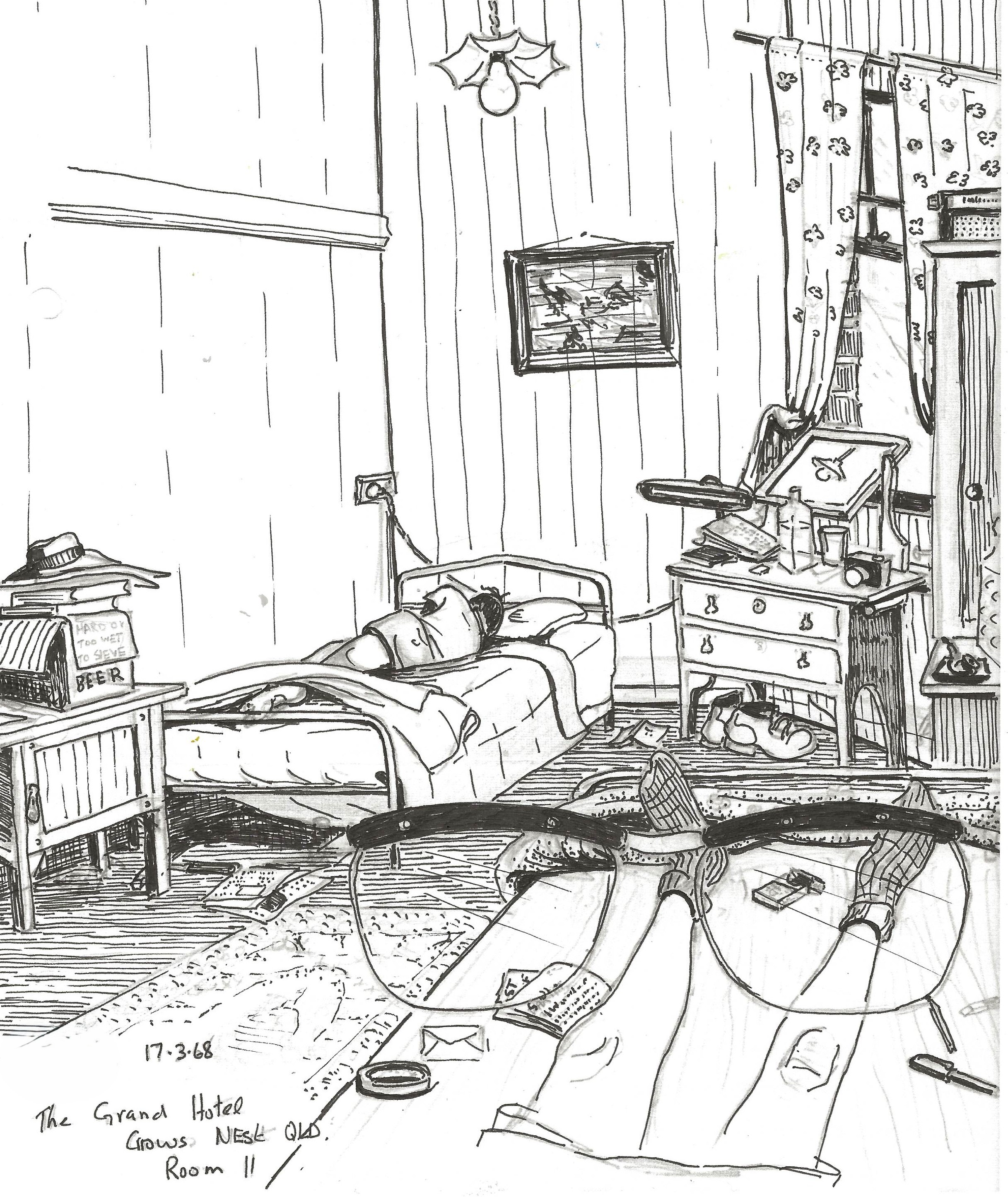
Long summer weeknights in the Grand Hotel, Crows Nest
But on Saturday the town was busy, even roisterous, as the farmers came into town for shopping, a meal at The Grand and to socialise after a hard-working week…
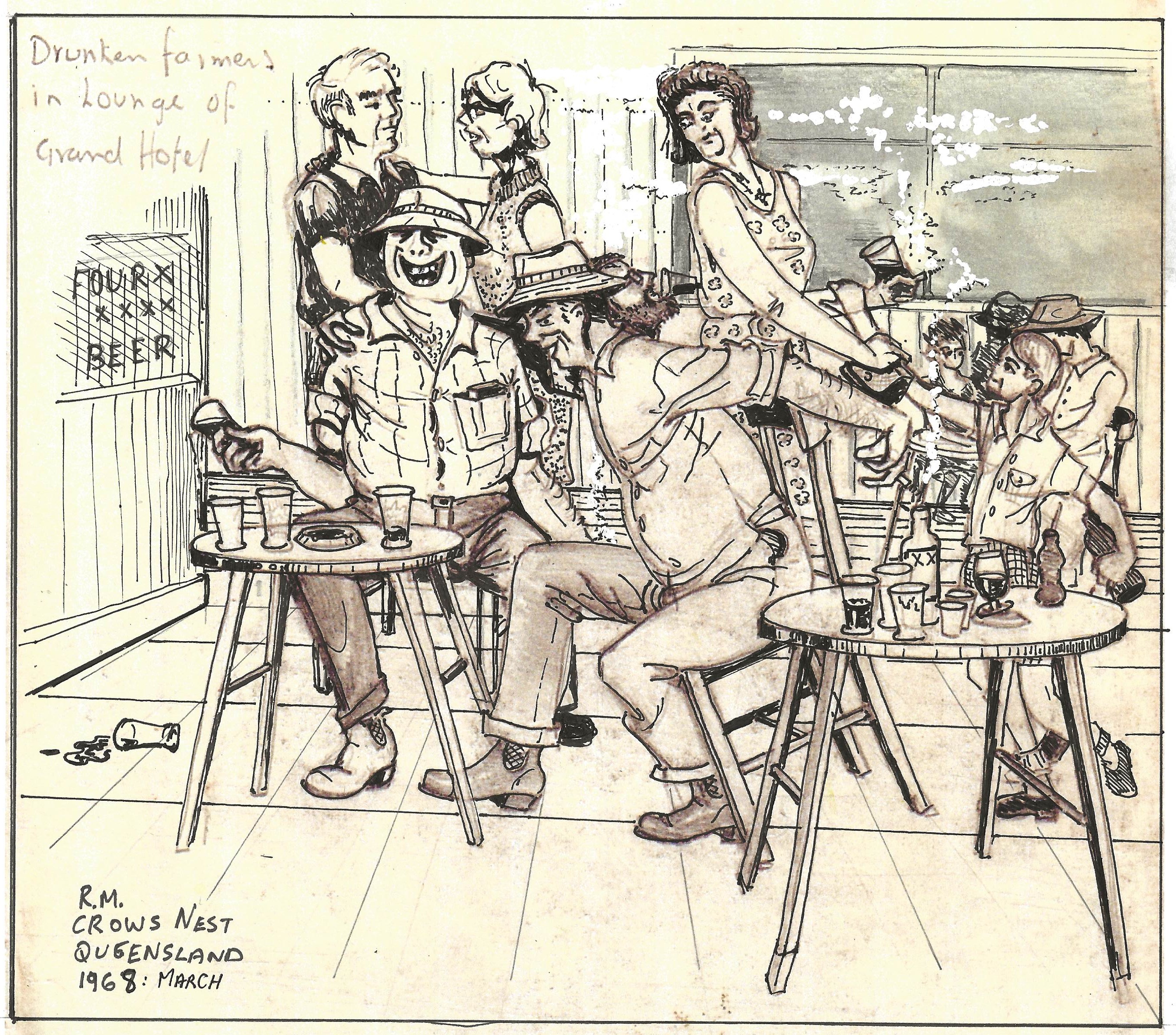
Saturday night in the Ladies Lounge at the Grand Hotel.
Back to the Story
Early in our acquaintance, Bill told me that sometime previously when he was staying in a hotel at Nanango (50km north of Crows Nest), he was approached by a local man called Nobby [7], who made a living drilling water bores for farmers. Nobby had told Bill that around the headwaters of the Yarraman and Meandu Creeks (north-flowing tributaries of the Burnett River, 30km north of Crows Nest) many of his boreholes had encountered seams of coal.
At that time, drilling for agricultural water was subsidised by the State Government, but drillers had to inform the Department of their results and provide a geological log for each hole. Bill decided to go to the State capital Brisbane to check this information at the Department of Agriculture. He would not have done this without the permission of our immediate supervisor, Gladstone-based geologist Ian Witcher. It turned out that, over the general area described by Nobby, almost every water bore sunk over a period of many decades had recorded coal in their logs (even rural water drillers had little problem identifying that black stuff in their cuttings). By contouring the results, an area prospective for coal mining in the southern Tarong Basin was outlined. Although many other coal occurrences were known in Queensland at that time, the attraction of the South Burnett Region was its good existing infrastructure and proximity to the population centers of SE Queensland.
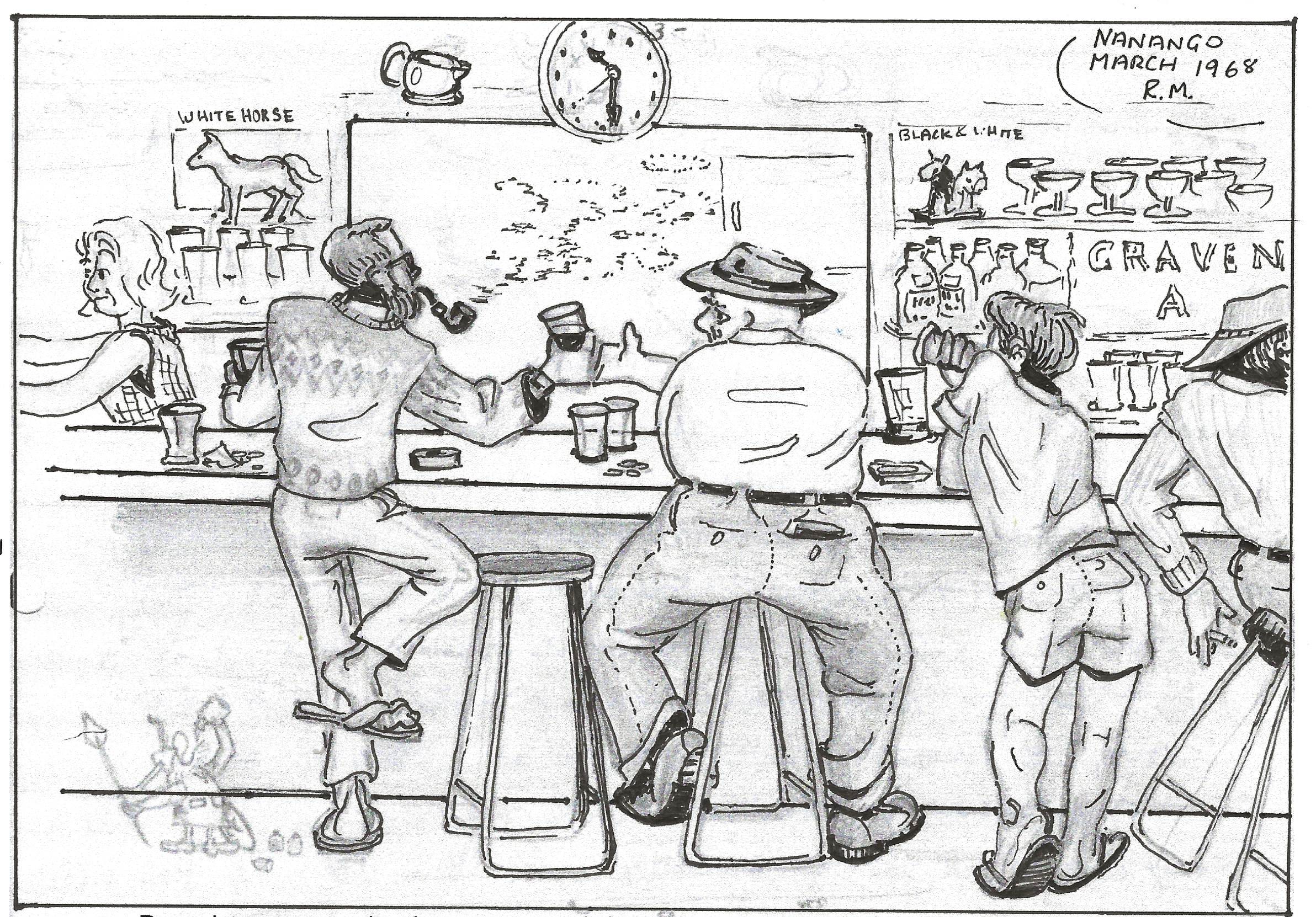
Me (smoking a pipe), Nobby [but see footnote 8] and Bill Johnstone in the front bar of a Nanango Hotel
Ian Witcher notified the Head Office of Rio Tinto Exploration in Melbourne. The company’s Exploration Manager – the legendary Australian mining Geologist Haddon F King – made the strategic decision to pivot exploration in the South Burnett area from base metal to coal. The first diamond drill hole to test the coal potential of the Tarong area was planned for the center of the best legacy water bore results.
For whatever reason (I was the most junior geologist on site), I was tasked with geologically logging this hole. It was collared on the top of a low ridge in the Meandu Creek area: a hill clothed in dry grass, scrub and stands of Eucalypt trees with some clearing for pasture on the lower slopes. All now long swallowed up by the later mine.
Prior to drilling, although outcrop was poor, I attempted to make a surface geology map. A conglomerate was exposed on the hilltop – an outlier of the basal unit of a late, overstepping formation. On the lower slopes, some surface float of sandstone only. Along the new drill access track the dozer blade had exposed outcrop of a soft, rubbly, buff-coloured sediment which I confidently identified as mudstone. All units were flat lying.
The 200m vertical drill hole presented the easiest logging exercise of any I have ever attempted. Layer cake stratigraphy; well-bedded sedimentary lithologies dominated by sandstone, siltstone, mudstone and coal; sharp contacts between units; little post-depositional deformation. In first 100m, the drill hole encountered at least five coal seams ranging from 1 to 25 meters thick, the first seam only 20m below surface.
After the ancient metamorphic rocks of the Territory, I thought coal geology a piece of cake (layer cake). But the “mudstone” I had observed at surface turned out to be heavily weathered coal. So much for my surface rock recognition skills.
My association with the Tarong project ceased at this point as I was transferred to another project in Papua New Guinea (see HERE). Someone else was brought in to replace me. Hopefully someone with more knowledge and experience of coal exploration than I.
The Moral of my Story
The discovery of Tarong is a good example of a general principal for the exploration geologist: when you are exploring an area, always seek out local knowledge. If someone, knowing a company geologist is in town, approaches you with an interesting rock specimen he has found, treat him (it’s always a him) with respect. Listen to his story and make sure you protect his interests if you or your company follows up on any new knowledge or insight he has brought you.
In 1962, Lang Hancock, a cattle station owner in the Hamersley Ranges in the remote northwest of Western Australia, brought the iron ore potential of the area to the attention to Rio Tinto. He was rewarded with a generous ongoing royalty from Rio’s subsequent, hugely profitable iron ore mines. Hancock died in 1992, but the royalty stream continued. Hancock’s only child Gina Reinhart, who had grown up on her father’s Mulga Downs station, leveraged her small inherited fortune into a much greater one to become today Australia’s richest person with over $46 billion (US$32 billion) in assets.
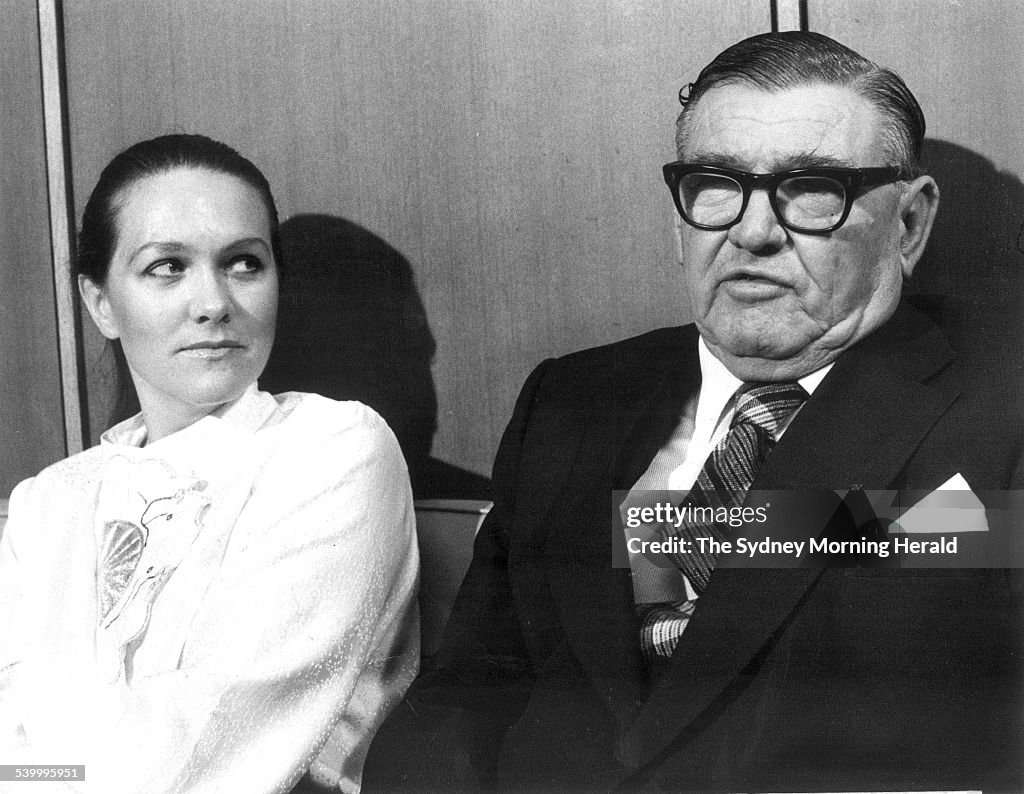 Lang Hancock and his daughter Gina, circa 1980. Photo by the Sydney Morning Herald.
It is very likely that the well-publicized story of Lang Hancock’s new-found wealth prompted a Nanango resident called Nobby to approach a Rio Tinto geologist in a Queensland pub in late ’67 or early ’68.
That geologist was Bill Johnstone. His decision to follow up on Nobby’s local knowledge was the key to the discovery of the Tarong coal deposit.
Epilogue
After I left Queensland, Bill’s career and mine took different paths and we never met again. Much later, I was told by a mutual acquaintance that when Rio lodged a Mining Lease over the Tarong deposit, Nobby was given a similar royalty deal to that of Lang Hancock on any future coal sales by Rio Tinto in the South Burnett Region. I was also told that Bill subsequently married one of Nobby’s daughters. Although I have no independent verification for any of that, if it is true, good luck to them both. They deserve it.