(Reformatted and with new material, March & July 2026)
A glimpse of the Future
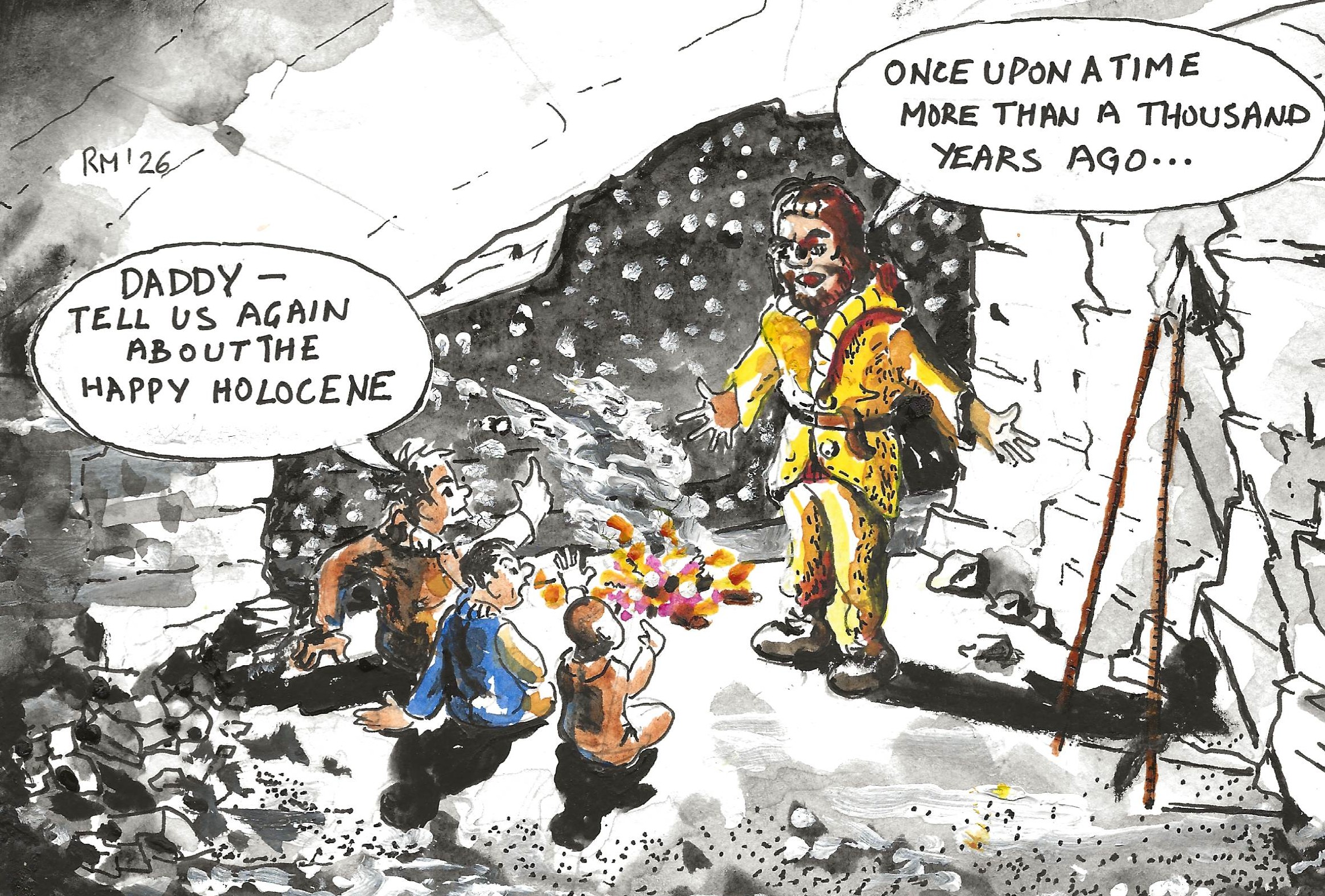
There is good evidence that the next advance of the earth’s glaciers will occur within the next thousand years or so. Maybe less. A catastrophe for humanity, but I am optimistic enough to suppose that as a species we will survive. Our few remaining short-lived descendants, as they shiver before fires at the mouths of their caves will tell each other stories of a legendary past when their long-lived ancestors enjoyed a life of abundance in a former Golden Age – the Happy Holocene.
Meanwhile, back in the Holocene…
Today our technology is so advanced that more than 60% of its 8 billion plus citizens are free to pursue fields of skill and knowledge that have nothing directly to do with food production. In developed, industrialised nations, that percentage must be nearer 90%.
One of these fields of knowledge is geology.
The International Union of Geological Sciences (IUGS), founded in 1961, is the peak governing body of geology. Under its aegis are a number of Commissions covering such things as Structure and Tectonics, Geochemistry, Ethics, History of Geology, Geological Education and so on. The oldest and probably the most important of these Commissions is the International Commission on Stratigraphy (ICS) which is tasked with responsibility for the subdivision of geological time going back 4.6 billion years (4.6 Ga).
To Fully Understand this Post, you will Need to Know How Geologists Sub-divide Time:
Time divisions and subdivisions are based on the stratigraphic record – the sequential accumulation of sediments and the fossil assemblages (if any) within them. Boundaries between subdivisions are based on significant, widespread and geologically rapid, transitions in the overall depositional environment. Localities where these key transitions are well exposed are referenced as type-localities and dated by isotopic methods. Each distinctive rock/fossil assemblage (divisions and subdivisions) are given a name, thus reifying them as a “thing”. Many of the names go back more than 200 years and reflect the happenstance of early geological research (see my previous post, The Invention of the Paleozoic). On a stratigraphic chart, time divisions are organised by nested hierarchies of ever smaller intervals of time. Eons (sometimes called Eonothems) are the longest: there are four of these in the 4.6 Ga geological record. Together, these four Eons are subdivided into fifteen Eras (Erathems), and these fifteen Eras together contain twenty-six Periods (Systems). Between them the Periods contain 38 Epochs (Series), and the Epochs themselves contain over a 100 Stages (Ages).
A Stage has the shortest time interval and the smallest geographical extent of any of the time divisions.
The boundaries of Eons and Eras are based on changes of global extent in tectonic processes, atmospheric composition and biospheric evolution and reflect the evolution of these forces over time. However, as will become apparent, the boundaries of Periods, Epochs and Stages are much more dependent on locally available evidence, subjective judgment of experts, and the historical development of classification schemes.
If we consider the stratigraphic chart as a Library of Time, then the Eons are books, the Eras chapters, the Periods paragraphs, the Epochs sentences, and the Stages words. The last words of the last paragraph of the last chapter of the last book to be added to the library are: “to be continued…”
To carry out their task, the ICS created a number of Sub Commissions, each responsible for one of the 26 Periods in the stratigraphic record. The most recent Period, the one we live in today, is known as the Quaternary and is defined by the start of the Pleistocene Ice Age around 2.58 million years (2.58 Ma) ago.
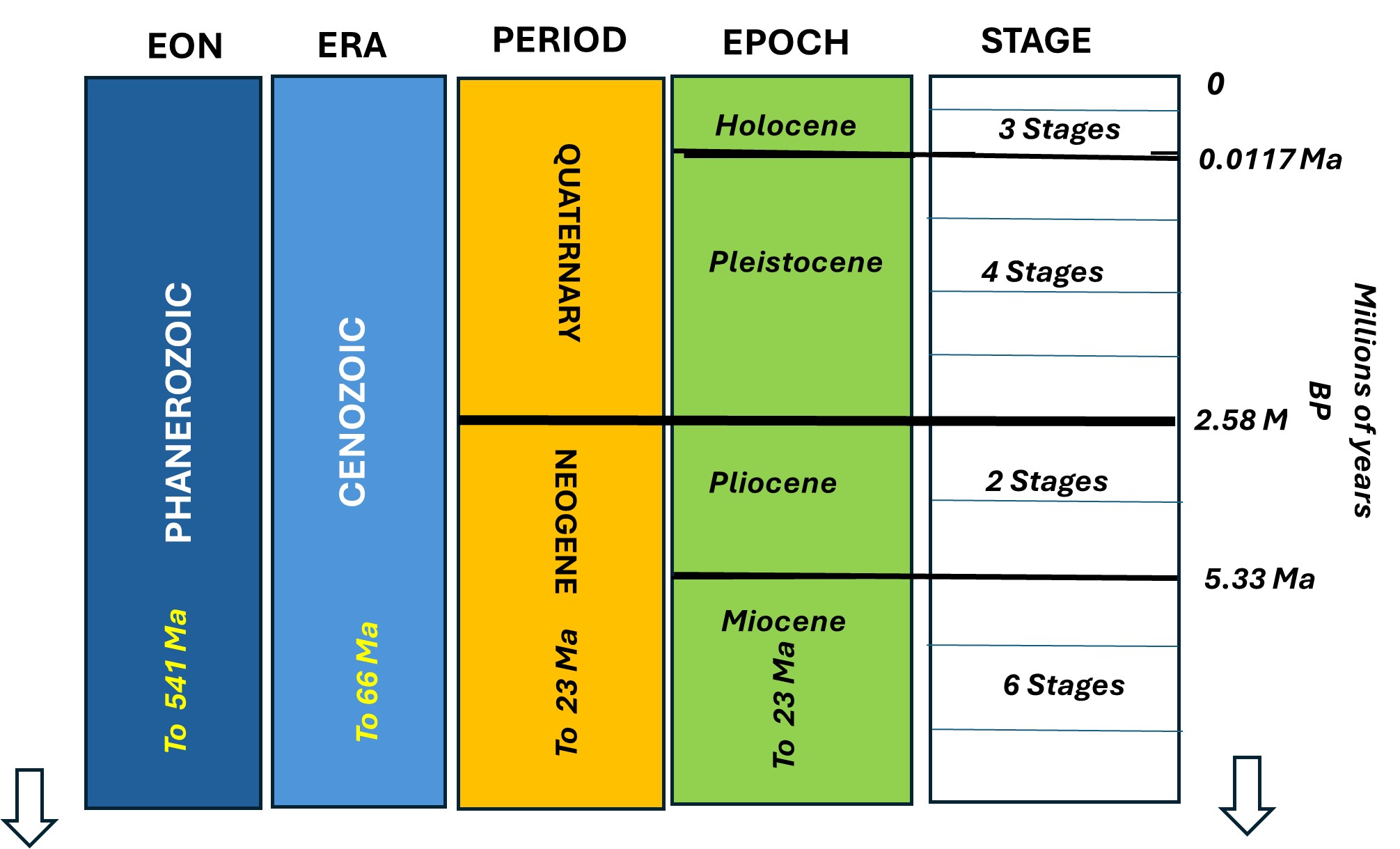
Geological subdivisions of the recent past, according to the ICS. Redrawn from their official chart.
How the Cenozoic Era Began
A little over sixty-six million years ago (66 Ma), a 10 km wide rogue asteroid, travelling at 40,000 kph collided with what is now the Yucatan Peninsula of Mexico. It caused a 200 km wide impact crater (called the Chicxulub Crater). The ejecta from the impact rapidly spread around the world. The epicenter of the crater is now partially offshore and buried beneath 1000 meters of later sediment.
The event was a global catastrophe that caused the near instantaneous extinction of 75% of all species of life on earth, including the non-avian dinosaurs. It was one of the greatest mass extinctions in the history of life on earth.
The ejecta settled as a worldwide, distinctive, centimeters-thick, sedimentary marker for the end of the Mesozoic Era (the Age of Dinosaurs) and the beginning of the Cenozoic Era.
Loosely translating geological time scales into human time scales, the Chicxulub meteor struck the earth two days ago at 4.23pm.
An Overview of Cenozoic Temperatures

Graph A: Cenozoic temperatures over the past 65 Ma. The Quaternary Period and the Pleistocene Epoch begin at 2.6 Ma on the extreme right of the graph (labelled here as the Pleistocene Ice Age).
For the first 20Ma of the Cenozoic, global temperatures were 10-15°C higher than today, supporting a burst of adaptive evolutionary radiation of Orders, Families and Species of life to fill the ecological niches vacated through mass extinctions at the time of the meteor impact. Most Mammalian Orders, including that of Primates to which we belong, evolved during this time. The earth was free of permanent ice.
This Period of the Cenozoic is known as the Neogene.
Beginning around 45 Ma, the Hothouse temperatures which had prevailed during the Neogene commenced a long slow fall. By 35 Ma, permanent ice sheets had become established over the Antarctic Continent and the crests of the higher mountain chains. By 2.6 Ma, permanent ice sheets had also formed over Arctic regions. Permanent ice at both poles is the geological definition of an Ice Age.
A new Period (the Quaternary) and Epoch (the Pleistocene) of the Cenozoic Era had begun.
The Quaternary Period
The lower boundary (i.e. the beginning) of the Quaternary and the Pleistocene is defined by the start of the Pleistocene Ice Age.
Temperatures plummeted, and kilometer-thick ice became generally established over land and sea at high- to mid-latitude areas around both poles. These extreme cold conditions are known as Glacial and they affected the nature of sediments, and the fossils within them, that were deposited all over the world.
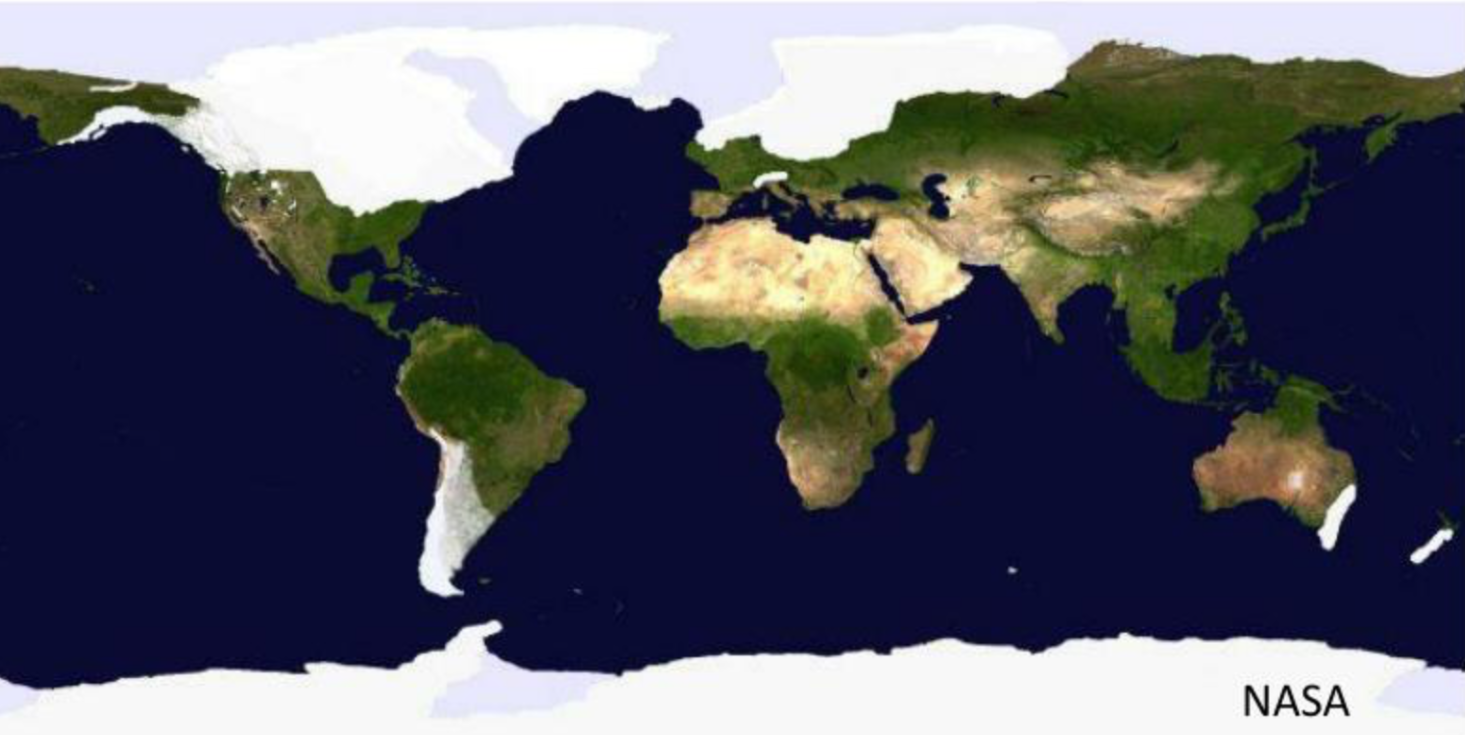 The maximum extent of Ice sheets during the last glacial episode 20-30,000 years ago. Image source, NASA.
The end of the Pleistocene Epoch should therefore be when glacial conditions cease for a significant period of geological time (i.e. at least a million years). That has not happened yet. Considering the duration of previous Ice Ages, each of which lasted many tens of millions of years (such as the Sturtian Ice Age in the Proterozoic Eon around 700Ma, the “Snowball Earth” Ice Age at the end of the Ordovician Era around 440Ma, or the long-lived Late Paleozoic Ice Age centered around 300Ma), the Pleistocene Ice Age – to date only 2.6Ma old – has millions of years yet to run. (see my post, Climate Change Explained in Three Graphs). Nor are the general icy conditions of the Pleistocene ameliorating with the passage of time. The opposite is true. Glacial advances in the latter part of the Pleistocene, starting around a million years ago, have been longer, colder and more extensive than those of the earlier part of the Epoch. The change to longer glacial/interglacial cycles and colder glacial temperatures is referred to as the Mid-Pleistocene Transition.
The geological evidence shows that the Pleistocene Ice Age is becoming colder and more extreme with time.
As Ice Ages go, it has only just begun.
The Holocene
We live in the Holocene – an interval of ice retreat, relatively warm temperatures and sea level rise. It began with a steep rise in temperatures around 11,700 (0.0117 Ma) years ago.
Pleistocene geological records show the presence of 45-90 similar short-lived retreats of ice (the exact number depends on how their start and end dates are defined). These milder conditions are known as Interglacials and make up around 20% of Pleistocene time. The Holocene is the most recent of these Interglacials and is not (so far) significantly different from any of the previous ones (see graph below). It is “warm” only with respect to the preceding glacial conditions. Compared to pre-Pleistocene temperature it is catastrophically cold.
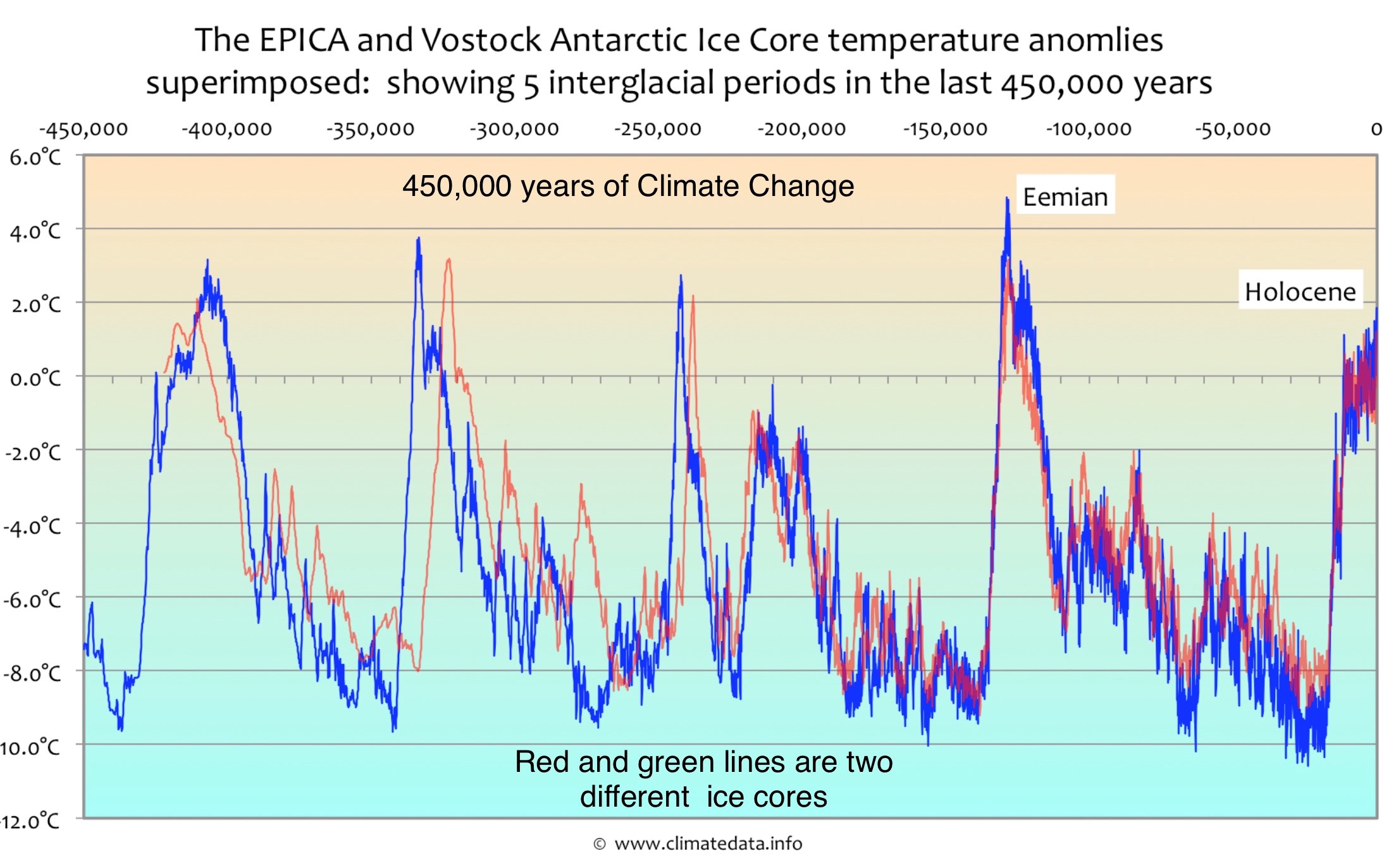
Graph B: Temperatures during the last 0.45 Ma of the Pleistocene as measured in Antarctic ice cores. Five Interglacial events are recorded, the last two labelled Eemian and Holocene. Data from www.climatedata.info
During the last interglacial (the Eemian), elephant and hippopotami gamboled on the mud flats of the River Thames. With the return of glacial conditions, these species migrated south but, 120,000 years later with the arrival of the Holocene, another species of large out-of-Africa mammal gambols, once again, on the banks the Thames.
Graph B, above, shows changes in air temperature (blue) and CO2 concentration (red) over Antarctica, as measured in the VOSTOK and EPICA deep ice cores. Broadly similar graphs can be produced for other regions of the globe, but the Antarctic data provides the best resolution. The graph covers the last 20% of the Pleistocene. Five upward spikes in temperature are apparent: these are Interglacial episodes of ice retreat – the last two labeled on the graph as “Eemian” and “Holocene“. During the 10,000 year-long Eemian, West Antarctica and the Ross Sea were ice fee (Nature Geoscience 2026, https://doi.org/10.1038/s41561-026-1988-1).
The Emperor Penguins in the south, the polar bears in the north and the coral reefs in the middle survived just fine.
There is another important takeaway from this graph: there is good correlation between temperature and CO2, but the peaks and troughs of CO2 consistently lag the peaks and troughs of temperature by 500-1000 years. This tells us that, whereas temperature might plausibly be acting as a control on atmospheric CO2 levels, CO2 cannot be controlling temperature (since an effect cannot precede its cause).
Holocene Temperatures
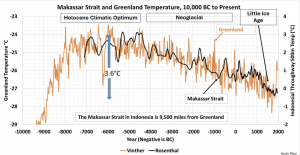
Graph C: Greenland ice core data from Vinther et al 2009: https://www.nature.com/articles/nature08355. and Macassar Strait benthic sediment data from Rosenthal et al 2013 http://science.sciencemag.org/content/342/6158/617. Compilation of the two data sets onto one graph with a common scale is by Andy May.
Graph C shows air and sea temperatures over the past 10,000 years – the last 85% of the Holocene. The temperature data come from oxygen isotope ratios measured in ice cores from Greenland (orange line) and sea-floor sediment (benthic) cores from the Western Pacific (black line). The good correlation of temperature variation with time between regions on opposite sides of the globe, based 0n two completely different deposit types, is compelling.
Other graphs of Holocene temperatures using different proxy methods and from different locations around the globe have been published. You can view a comparison of these graphs, in Nature Science Data, 2020 HERE. Although differing in detail, they all show a similar pattern to graph C.
From the graph we can see a steep initial rise in Holocene temperatures to a plateau around 10,000-6000 years ago. This time interval is known as the Holocene Climate Optimum when average temperatures were 2-3°C above those of today. “Optimum”, that is, with respect to life on earth. During the HCO, the only permanent ice to survive in the world were those of Antarctica, Greenland and the crests of the high plateaux of the great mountain ranges.
The HCO was followed by a slow decline in global temperatures and the reappearance and steady advance into lowland areas of mountain glaciers, reaching their maximum extent during the informally named Little Ice Age. The LIA began around 800 years ago and lasted until the middle of the 19th century. Its coldest temperatures (nadir) occurred during the 17th Century. This was a century where around the world failed harvests, epidemics, invasions, revolutions, civil war, religious pogroms were the norm. As an additional evil in Europe and North America, thousands of harmless old women (and a not a few men) were blamed for the troubles and judicially murdered for witchcraft.
See “Global crisis: Climate Change and Catastrophe in the 17th Century” by Geoffrey Parker, 2013, Yale University Press: ISBN 978-0-300-15323-1;
also “The Crisis of the 17th Century” by Oxford historian Hugh Trevor Roper, 1967, Liberty Fund, ISBN 978-1-61487-084-4). (Writing in the 1960s, Trevor Roper makes no mention of Climate Change, but the crises he meticulously describes are real enough).
During the Little Ice Age, the world had a modest foretaste of what a return to full glacial conditions might mean for our civilisation. And that return is inevitable. Note: this will not be a return to a NEW ICE AGE, but a return, after temporary respite, to normal conditions for the Ice Age we already live in.
Is the Holocene Unique Among Pleistocene Interglacials?
Comparing graphs B and C, all the interglacials of the Pleistocene for which we have sufficient resolution show a similar strongly skewed pattern – a steep initial rise to a plateau, followed by a long slow fall to Glacial or Neoglacial conditions. The relentless decline in global temperature following the Holocene Climate Optimum follows this pattern and provides an ominous pointer to the next episode of Pleistocene glaciation.
Beginning around 100-150 years ago (at the extreme right of the ice-core data of graph C), there is a steep upward spike in global temperature of 1-1.5° C. This is the Modern Warm Period (MWP) – the subject of much current existential angst from scientists who, if they knew even a modicum of geology, would and should know better (see my previous post HERE). But modern global temperatures are only “warm” when compared to the anomalously low temperatures of the preceding Little Ice Age.
From graph C we can also see that increases and decreases in global temperature of up to 3° C, over relatively short time periods, have occurred every 500-1000 years or so throughout Holocene time.
Compared to temperatures that were normal for the greater part of the Holocene, conditions today are relatively cool.
Compared to temperatures that were normal for the first 60 million years of the Cenozoic – when life on earth boomed – conditions today are catastrophically cold.
There is nothing unusual or remarkable about the Holocene other than that it approximately corresponds with, and helped facilitate, the rise and rise of our civilisation.
There is nothing unusual or remarkable about the Modern Warm Period other than that climate scientists happen to live within it.
But the Internation Commission on Stratigraphy Interprets Pleistocene Data Differently
According to the ICS, and with the approval of the IUGS, the Pleistocene Epoch (or Pleistocene Ice Age) finished, terminated and collapsed forever 11,700 years ago (0.0117 Ma), to be replaced by the Holocene Epoch. These august bodies must therefore consider that the Holocene interglacial is fundamentally different from the numerous interglacials that preceded it.
To be logically consistent, if the Holocene is a separate Epoch within the Quaternary, then all previous Interglacials and Glacials of the Quaternary must be judged as Epochs also. With 90 or more Epochs, the Quaternary would then contain more than three times as many Epochs as all other 26 Periods of the stratigraphic record combined. An absurd proposition. And the Quaternary is not finished yet.
In this dilemma, the ICS appears to be trapped in an epistemological maze with no clear roadmap to follow.
Because the sediments are recent, stratigraphers of the Quaternary have a plethora of available evidence enabling them to create ever finer subdivisions of geologic time. But that is no excuse to elevate these micro-divisions to the status of “Epochs”. Otherwise, we would have to conclude that an Epoch of the Quaternary is equivalent to a mere stratigraphic horizon of the Paleozoic.
If there is to be any logic and meaning to standard terms for the division of geologic time, consistency of definition is vital.
But, for the sake of argument, could the ICS be correct in concluding that the Pleistocene Ice Age ended around 12,000 years ago with the beginning of the Holocene? It will be another million years before we can be 100% certain of the answer to that question. But we don’t need to wait that long. Based on the evidence presented here, I am more than 90% certain that Pleistocene glacial conditions will return. Whether that be in 500, 1000 or 2000 years’ time, we just don’t know.
The members of the ICS apparently consider that, starting from the time of the cultural Neolithic Revolution (made possible by the benign climate of the early Holocene), we humans have caused sufficiently large changes to terrestrial sedimentary processes, fossil assemblages, tectonic movements, ocean currents and atmospheric make up to justify raising the status of the Holocene from merely the most recent of the many Pleistocene Interglacials, to a unique and new Epoch in its own right.
Whatever the reasoning of the ICS, this is certainly a controversial and debatable proposition.
As the late Carl Sagan wrote in 1979: “Extraordinary claims require extraordinary evidence”.
No such evidence has been presented.
But it Gets Worse…
Astonishingly, in 2019, the ICS made another proposal to the IUGS. Some among them advocated the creation of a new Epoch to succeed the Holocene Epoch. They called their proposed division the Anthropocene, a neologism from two Greek words meaning roughly: “The New Age of Man”. The Anthropocene began, they said, around 1950AD – a date apparently plucked from the calendar because it was a suitably round number.
To their credit, in 2019, the IUGS in a near-unanimous vote rejected the Anthropocene proposal. But that ridiculous term still is still being used by Climate Change activists as though it had some scientific validity.
Back to the Future…
A hardy few survive, hunters in the snow,
at night in caves with fires aglow.
Around the fires the women can be seen,
talking of the Happy Holocene.
An Age of abundance and long, long life,
lost in cold and hunger and endless strife.