It is surprising how often the least experienced geologists are handed the critical but laborious and sometimes tedious task of logging drill core.
My first job in industry was with the exploration arm of a large international mining company. It involved a lot of core logging. The department was organised along strongly hierarchical lines. Geologists at point in the field were regarded as mere data-collecting operatives, core logging automatons capable of so many feet per day, unimportant pawns on the board. We were not expected to think. Our data were passed up the line for interpretation by office-based superiors. Said superiors then passed down instructions on where the next hole should be drilled, or the next sample taken. From time to time, they would make trips to the field for brief supervisory visits.
When this happened, we pawns referred to them as “seagulls” – as in: “they fly in, shit on everyone, then fly out again” (1).
But never, of course, to their faces.
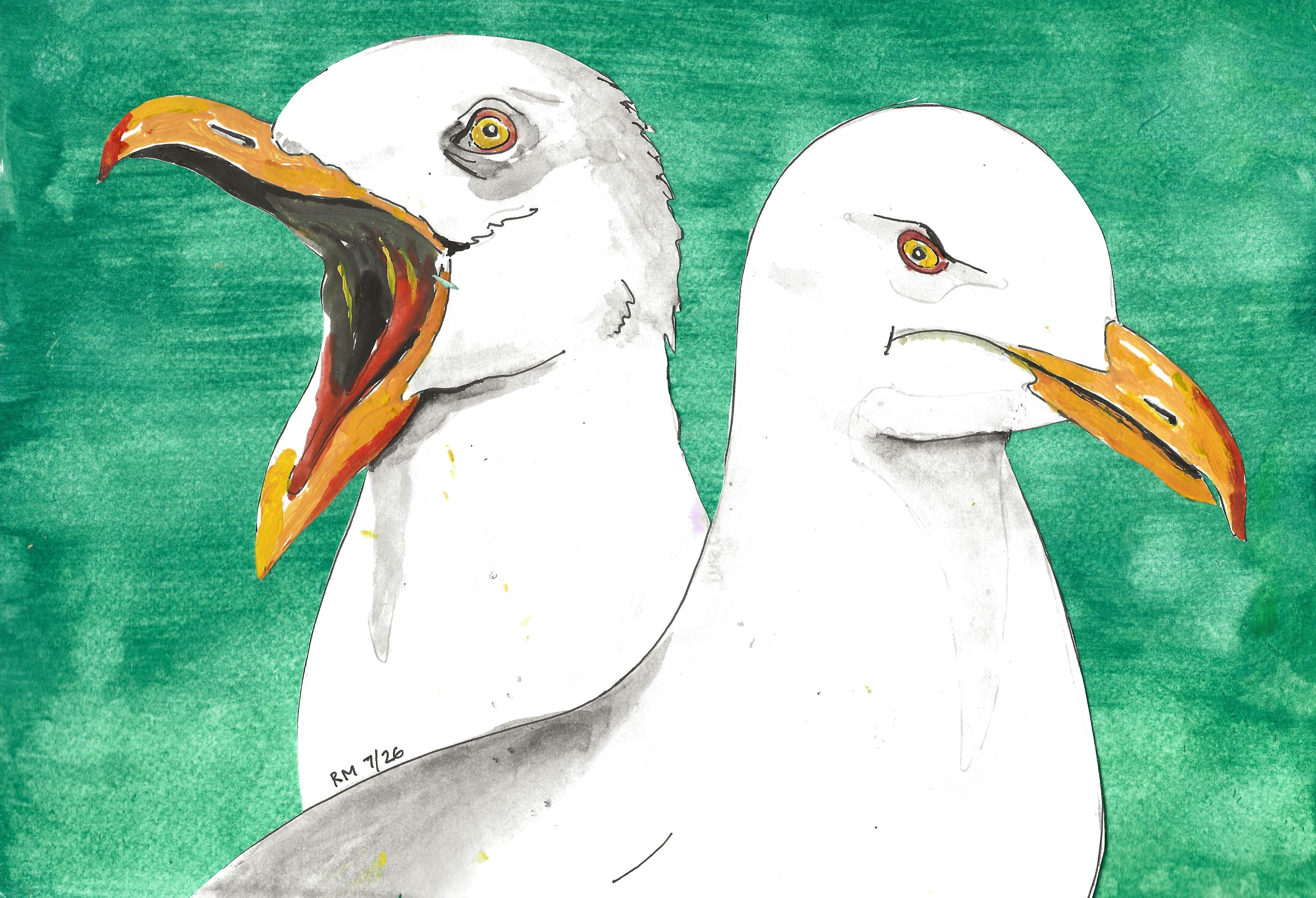
Seagulls, with attitude
Fortunately, not all my early career supervisors were seagulls.
After a few years, I moved on to work for much smaller (junior) exploration/mining companies. There, geologists worked in small teams where the more experienced among us could effectively mentor those with less. This is the best kind of mentoring: learning on the job, watching what experienced geologists can achieve and carefully noting how they do it (and, sometimes, how not to do it). At every level, all were expected to contribute. Critical decisions were discussed within the team. Never a democracy of course, but all opinions were heard and we felt involved in the process. The result was steep learning curves, identification with the company and committed efforts to contribute to its success.
It is important to listen to what someone says, but much more instructive to observe what they do.
Outside mentoring schemes, such as that organised annually by the Australian Institute of Geoscientists (AIG), are well meaning programs but have limited effectiveness. Early career geologists sign up because they hope to advance their job prospects by expanding their network of contacts. Nothing wrong with that, but it does nothing to advance practical exploration skills.
It is long since I heard the term seagulls used in the pejorative sense of this post. Perhaps that’s because I eventually became a seagull supervisor myself, although I always strove not to deserve that epithet.
Are exploration groups managed better these days, or are we just more polite and deferential? Has the Aussie larrikan spirit been lost in a sea of conformity?
******
(1) I made a quick search on the internet for information on my use of the word “seagulls” but in vain.
I found many pages on the “spiritual” meaning of seagulls, but I doubt many summer holiday beach goers see them that way.
The PETA website piously protests phrases implying animal abuse (e.g. “Killing two birds with one stone” or “There’s more than one way to skin a cat”). But these are powerful metaphors, removing them from the lexicon would merely impoverish our language with no benefit to animal welfare. And who would want to skin a cat these days anyway, apart from a taxidermist or (allegedly) a dodgy Chinese restauranteur?
But PETA have nothing to say about seagulls. I conclude my usage is an Australian original, popular in the 1970s.