“Whoever undertakes to set himself up as a judge in the field of truth and knowledge is shipwrecked by the laughter of the Gods.” Albert Einstein, 1953
Scientific knowledge is a body of statements of varying degrees of uncertainty – some most unsure, some nearly sure, none absolutely certain.” – Richard Feynman, Theoretical Physicist and Nobel Laureate.
“The unknown is the dark matter of all things, the greater part of the universe.” Geoffrey Weiss, 2021
Fact and Truth
At the most fundamental level, the idea of a fact, and the related but more morally portentous concept of truth, are ideal philosophical concepts that we seek but can never be certain to have achieved.
In one of his Dialogues (The Republic, Book VII) the 5th century BC Greek philosopher Plato compares the physical world that we see and measure to shadows on the wall of a cave made by something “out there”, beyond our direct vision. In this allegory, the cave is our skull, imprisoning our brain: the “something out there” is an external reality of fact and truth. We are condemned to remain forever in our cave, observing, and analyzing the shadows on the wall and speculating as to what they might mean.
“Fact” and “truth” are loaded words all too often used as a means of asserting authority and pre-empting debate. When you say, “this is a fact” or “the reality is” or “the truth of the matter is”, you are saying in effect, “you may not dispute this”. They are polite ways of saying that those who disagree with you are deniers, heretics, contrarians, ignoramuses or just plain stupid.
Recall, from your own experience, how often in debate these phrases are used to introduce a controversial statement that the speaker knows you might well not accept and wants to ring-fence in advance against your anticipated scepticism. Phrases such as “in fact…” or “the truth is…” are rhetorical figures of speech that we all use in conversation as a means of emphasizing the strength of our belief. Nothing wrong with that, they are useful for casual conversations. In fact, and in that context, I use them too, but you are entitled to respond: “that’s not a fact, it’s just your opinion” – or – “where’s your evidence?”.
Quoting “fact” and “truth” are always to weaponize these words in pursuit of an agenda: to persuade, to win an argument, to convince a doubter, to change an opinion. Evidence for this abounds in all fields of communication: the words “fact” and “truth” are stock phrases used in advertisements to convince you to buy a product; they populate the language of journalists and of politicians [1] trying to convince their readers or influence their electorate.
Claims of absolute fact and enduring truth properly belong to the realms of faith and belief. Scientific Knowledge is not based on faith or belief but on physical evidence and deductive reasoning: its conclusions are always provisional and subject to the next observation, of which the best we can ever say is that the new data has failed to falsify the original observation or idea. Failure to falsify gives you the confidence to think that you might be on the right track, but it does not constitute proof. At any rate, that is the ideal and is the process which has underpinned the advance of scientific knowledge, created its successes and given it authority to speak on the natural world. Evidence (and its digital version, data) is not the same as fact, though the two ideas are often conflated. “Alternative evidence” is a valid subject for discourse and argument, but “alternative fact” is an oxymoron (2).
There is only ever one way that an observation or an idea can be true, but there is a very large number of ways in which they can be false, including the multiple ways that neither you nor anyone else has yet thought of. All else being equal, the more ways that an observation or a theory can be false, (and you have no idea how many ways there are) the more the likelihood is that it will be false. Black Swan Events happen all the time.
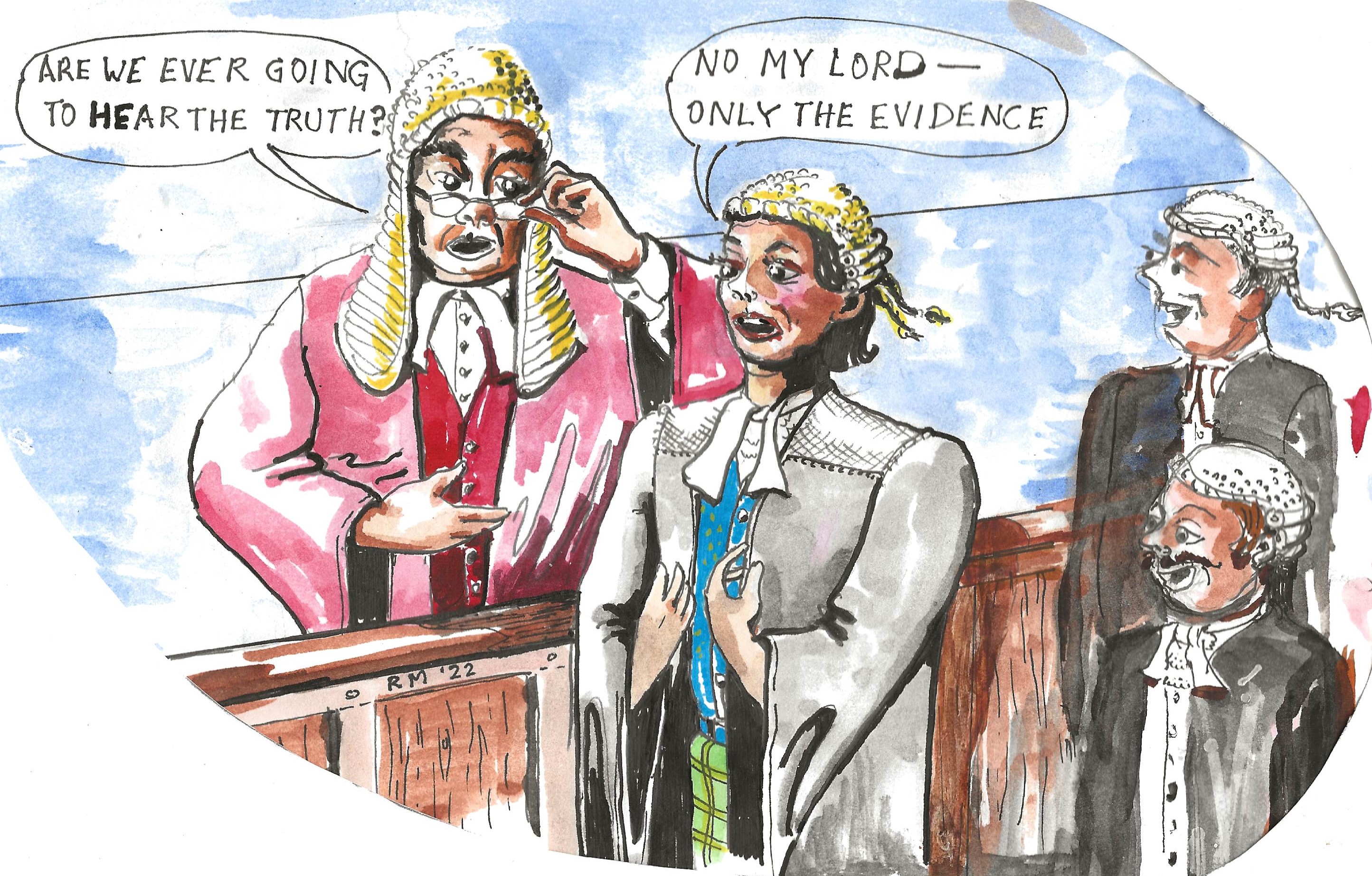
Old Legal joke)
I Digress here to the Law
Or, more specifically, to Criminal Jurisprudence. This subject provides a good way of illustrating the difference between fact and evidence, truth, and opinion. Lawyers prosecuting or defending a person accused of crime get equal time to present evidence – which is often conflicting – to an experienced judge or a randomly-selected 12-person Jury of their peers. It is then the job of the Judge or the Jury, having heard all the evidence and all the arguments, to determine “fact” by giving a guilty-not guilty verdict. Unless and until a guilty verdict is given, the null position (i.e. that the accused is innocent) is held to be true. But the legal definition of “fact” and “truth” to which the Jurors must adhere is limited and qualified. It is an opinion with which all 12 Jurors must agree and which they consider to be “beyond all reasonable doubt”, with the implied assumption that what is “reasonable” is available to all. And yet, despite this laborious, time-consuming and expensive process – the best that centuries of jurisprudence have yet devised – criminal courts often get it wrong (3).
Juries and Judges are human beings and not always rational or reasonable. They are subject to error, misunderstanding, ignorance, emotion, group think, peer pressure, societal prejudice, fashionable opinion, deference to authority and uncritical acceptance of expert opinion. And that list applies to journalists, politicians and scientists too.
“..one has to remember that the probable need not necessarily be the truth and the truth not always probable.” – Sigmund Freud
Returning to Science
At least the Lawyers have a definition, albeit limited and subjective, for what they mean by “fact” and “truth”. Many scientists, on the other hand, use these words to mean, like Humpty Dumpty in Alice in Wonderland, whatever they want them to mean.
The famous bio-statistician Sir Ronald Fisher (1890-1962) gave his definition of scientific fact in 1926, when he wrote (in that well-known publication, the Journal of the Ministry of Agriculture of Great Britain, 33, p 504):
“A scientific fact should be regarded as experimentally established only if a properly designed experiment rarely fails to give this level of significance..”
By “this level of significance”, Sir Ronald meant that the probability (known as p) that pure random noise in your data would yield your result is 0.05 or less (written p ≤ 0.05: meaning five or fewer chances in a hundred). If such a number can be calculated then, according to Fisher, a p≤0.05 enables you to call your result “statistically significant” and thus “a scientific fact”. But if p=0.05 is considered significant, what then do we call a p=0.06? And if we conclude (as we must) that number is also significant, what then of p=0.07 ? And so on. In other words, what is the logic of imposing an arbitrary cut-off in a continuum of potential results? This is not science, but simply a way of putting an illusion of quantitative rigor on fuzzy qualitative numbers. In fairness to Sir Ronald, he may have had in mind to define a “scientific fact”, in the manner of the Lawyers, as an inferior and qualified version of an actual fact. If that was his purpose, it was an insult to both Science and the English language.
By many accounts (4), for almost the last 100 years, researchers in statistic or mostly statistic-based sciences like Social Science, Political Science, Environmental Science, Climate Science, Medical Science – (5) – Psychology and Economics had to make sure they met Fisher’s arbitrary “wee pee” criterion if they wanted their work to be published in scientific journals (and negative results failing to make the cut left languishing in dusty file or trash can). But in recent years there has been a strong pushback against this misuse of statistics (6). I doubt that many scientists today would consider statistical significance to be synonymous with fact. However, most would consider a 95% or better chance that their research was on the right track to be the basis for a good working hypothesis, although they would never bet their lives on it.
None of the above is to dispute that an observation (evidence) can be so well established by universal experience that for all practical, everyday purposes it can be called a “fact” that few rational people would dispute without being dismissed as a nut case or, at best, a boring pedant (maybe you have already fitted me with one of these hats?). That the sun rises in the east or that the earth is round are all, by this definition, statements of fact (7). In my own profession, when a geologist produces a large-scale outcrop map and calls it a “fact map”, or refers to his field observations “ground truth”, I do not think we have to accept that his or her lines on a piece of paper can be described, even on this colloquial definition, with the same level of certainty (see my earlier Post on this subject: Is there such a thing as a geological fact map?).
Qualifications and Caveats
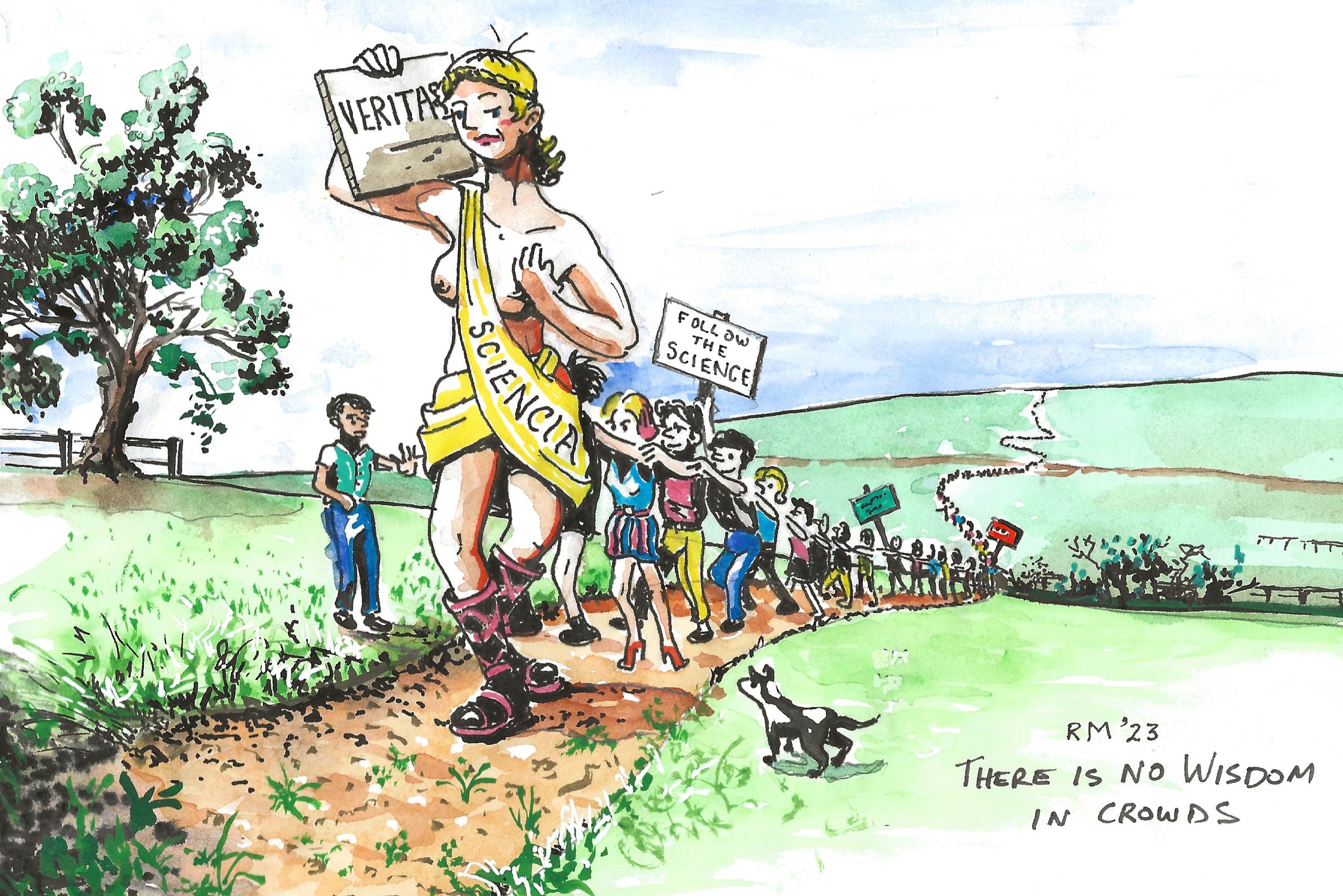
You may think from the above that I have strayed into the area of post-modern philosophy called Relativism (not be confused with Relativity). Relativism denies that there is any objective truth out there: the shadows on the walls of our caves are illusions. From this idea follows that all systems of knowledge are social constructs, and all such constructs, from Astronomy to Astrology, Dark Matter to the Dreamtime, Quantum Mechanics to Queer Theory, Relativity to Relativism, String Theory to Shamanism, have equal validity and truth (or lack thereof). The concept was widely disseminated in the late 20th century through, among others, by the works of French philosopher Jacques Derrida and his well-known phrase: “There is nothing out of context” or, in another translation: “There is nothing but words” (8).
That is not my opinion. That is the not the point I wish to make. The moon in the sky and the tree in the forest exist, even when no one is looking.
The Takeaway Message from my Essay is…
In their professional communications, Scientists should never use the words “fact” and “truth” and accept that their observations and theories are always subject to scrutiny, qualification, replication, skepticism and, potentially, retraction.
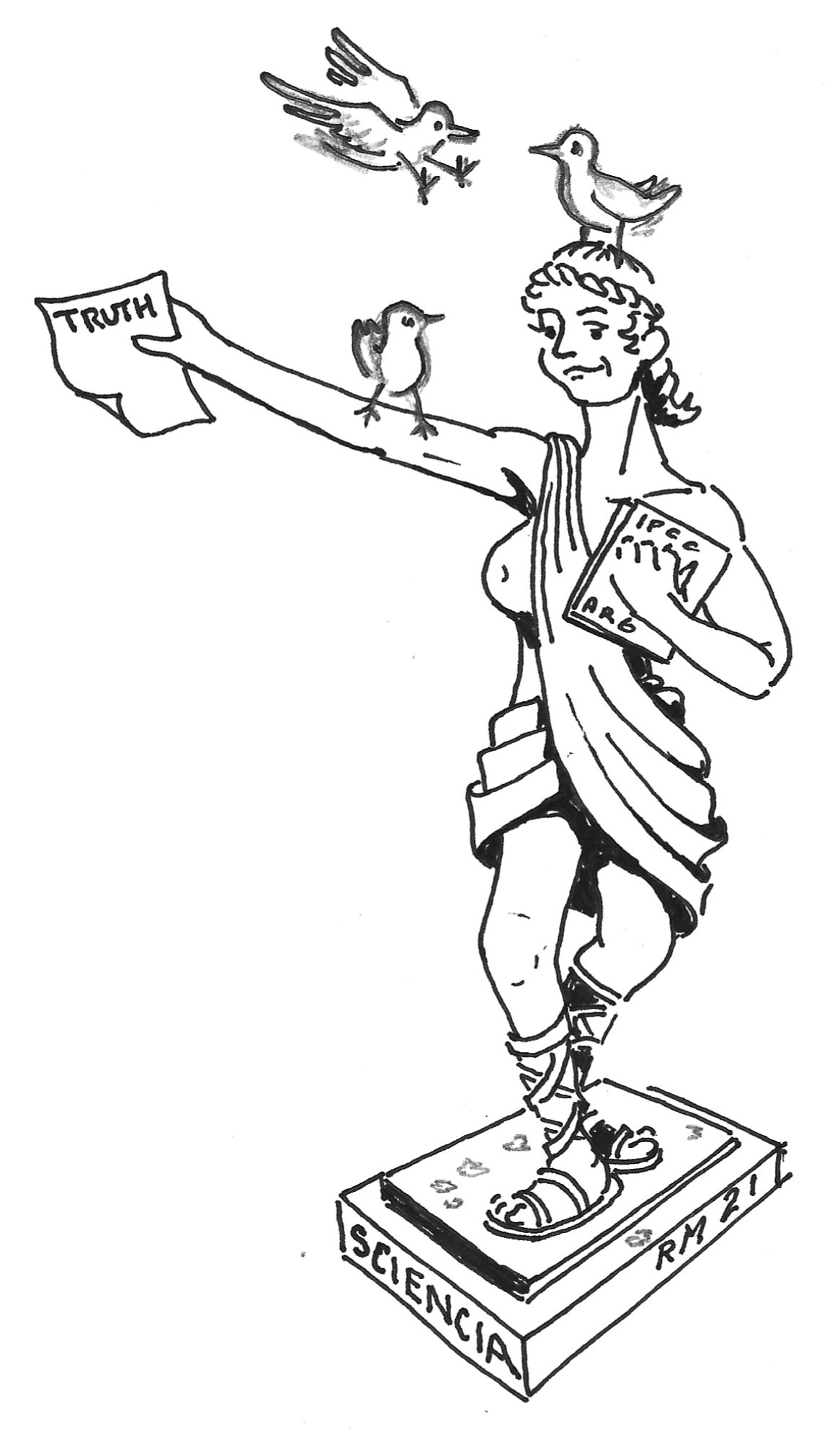
The purpose of scientific endeavor is to seek Truth, not proclaim it.
*****
(1) There are two good contemporary examples of the misuse of the concepts of Truth and Fact in popular media. The 2006 disaster movie “An inconvenient Truth” by Al Gore (a failed politician) and the 2019 BBC TV documentary “Climate Change: The Facts” by Sir David Attenborough (a TV journalist). Their technique was highly effective. Al Gore got a share of the 2007 Nobel Peace Prize for his efforts: Sir David got his second Knighthood (in 2022) for his.
(2) When Donald Trump’s campaign manager Kellyanne Conway used the phrase “alternative fact” in a 2017 interview she was widely ridiculed. “Alternative facts are not facts” spluttered her interviewer “They’re falsehoods”. And he was right. Kellyanne would have avoided the ridicule and subsequent pile-on, and been better able to argue her case, if she had used the word “evidence” rather than “fact”.
(3) As of 2023, in the USA alone, over 3200 convicted persons have been exonerated over the past 40 years as a result of the application of new forensic technologies, or through the debunking of previously accepted technologies. The number of innocent people still in jail must be far larger than those already exonerated (source: www.innocenseproject.org). For other egregious examples of miscarriages of Justice, Google the four women in the list below. In separate cases, in three different countries, these women were convicted of multiple infanticides and jailed on the testimony of scientists whose confident “expert” opinions were later proven to be false.
Lindy Chamberlin (convicted in Darwin 1982, pardoned 1988, exonerated 1989, compensated 1992);
Sally Clark (convicted London 1999, freed on appeal 2003, committed suicide 2007);
Lucia de Berk (convicted at the Hague 2003, freed on appeal 2010);
Kathleen Folbigg, Sydney 2003 sentenced to 40 years jail, pardoned and exonerated 2023, compensated 2026).
(4) See, Stuart Ritchie 2020: “Science Fictions: exposing fraud, bias, negligence and hype in science”. Penguin-Random House 353p.
(5) “…never trust a science with an adjective in front of it..” – anonymous internet blogger, 2019
(6) Valentin Amrheim et al., 2019: “Scientists rise up against statistical significance”. Nature 567, No 7748, pp305-307 https://doi.org/10.1038/d41586-019-00857-9 and: John Ioannidis, 2005; “Why most published research findings are false”. PLoS Medicine. https://doi:10.1371/journal.pmed.0020124 This is one of the most downloaded papers in the 20-year history of PLoS (Public Library of Science)
(7) The sun does not “rise”, this is an optical illusion: it is the earth that moves. (“Eppure si muove” – yet it moves – Galileo muttered as the Inquisition led him away). But the illusion fooled the best brains of humankind for countless millennia and is still built into the structure of our language. And the earth is not round: this is a convenient simplification, good enough for everyday discourse. Our planet is actually an asymmetric oblate spheroid – and a slightly lumpen one at that.
(8) What Jacques Derida actually wrote was: “Il n’y a pas de hors-texte”.
*****
This post incorporates some material from earlier post entitled Is there such a thing as a geological fact map? Roger Marjoribanks. First posted December 2022. Updated 2023 & 2026