Oxygen in the Atmosphere
Using the redox reactions of common rock forming minerals as proxy indicators, geochemists are able to form a rough reconstruction of the composition of the earth’s atmosphere throughout its multi-billion-year history (1).
For the first 2 billion years (2Ga) of the earth’s existence (from 4.6Ga - 2.5Ga) the atmosphere consisted largely of nitrogen and carbon dioxide, along with significant amounts of methane, ammonia, sulphuric acid and water vapor. Free oxygen was non-existent or, at best, present as a trace gas.
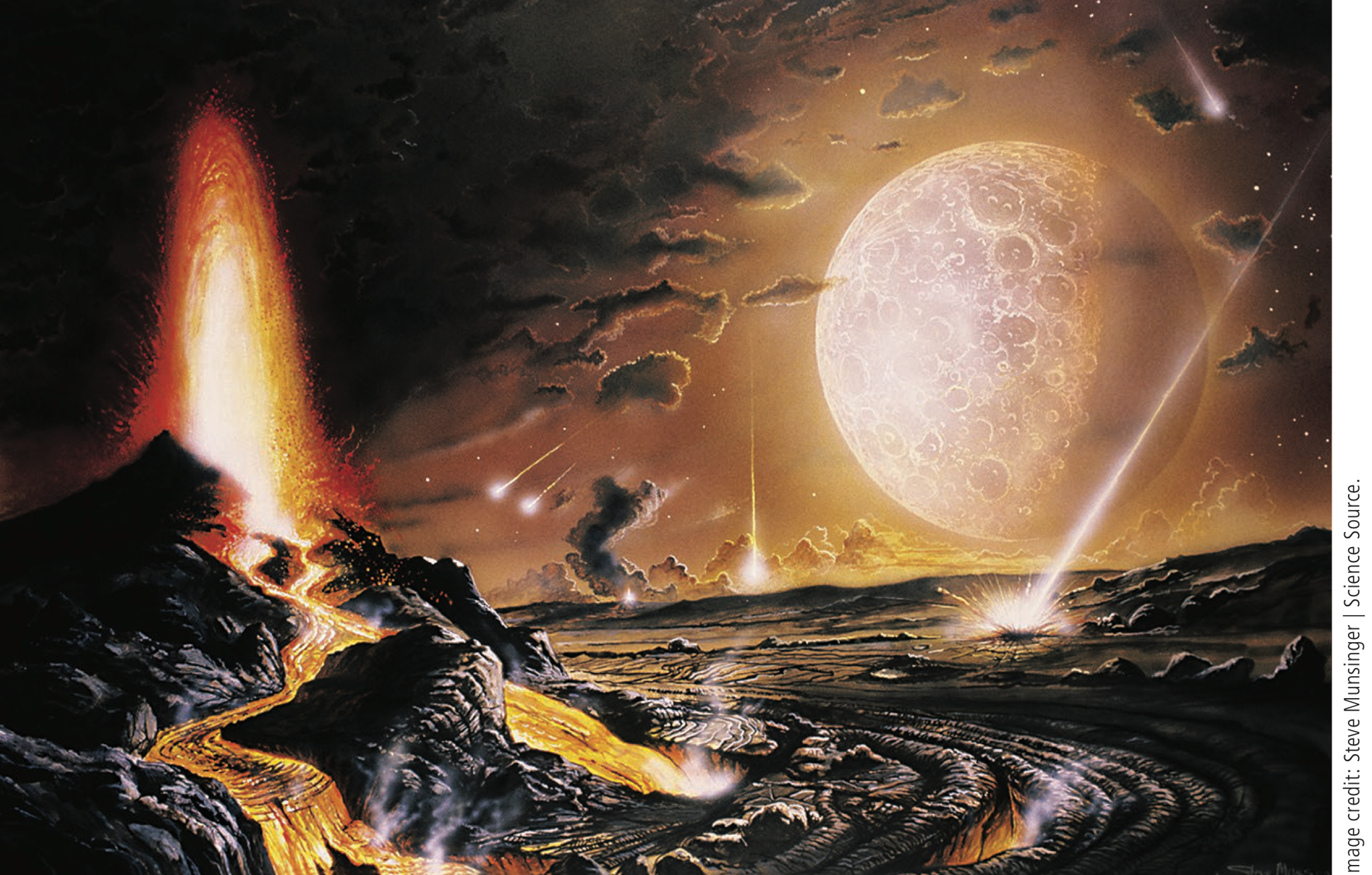 A depiction of the earth’s surface and atmosphere as it might have been during the first 0.5Ga of its existence (the Hadean Eon). A recently separated moon looms large on the horizon. Painting by Steve Munsinger.
Evolving in this anoxic reducing environment, anaerobic single-celled prokaryotic (cells with no nucleus) life first appeared in the waters of the world around 3.6Ga, deriving its energy from volcanic heat. After a few hundred million years of evolution, one of these organisms called cyanobacteria (a.k.a. blue-green algae) developed the ability to split the CO2 dissolved in oceans and seas into its constituent components of carbon and oxygen using solar radiation as an energy source.
Taxonomists classify blue-green algae as a class of bacteria, but they are a transitional species to the first true plants. Taxonomists always have trouble positioning transitional species in their classification schemes. Classification implies boundaries, but in evolution – the name gives the clue – there are no hard boundaries.
The biochemical process of splitting CO2 into carbon and oxygen that the cyanobacteria invented is known as photosynthesis. The carbon was used to make the organic compounds of life, releasing oxygen back to the atmosphere as a waste product. The oxygen content of the atmosphere slowly increased.
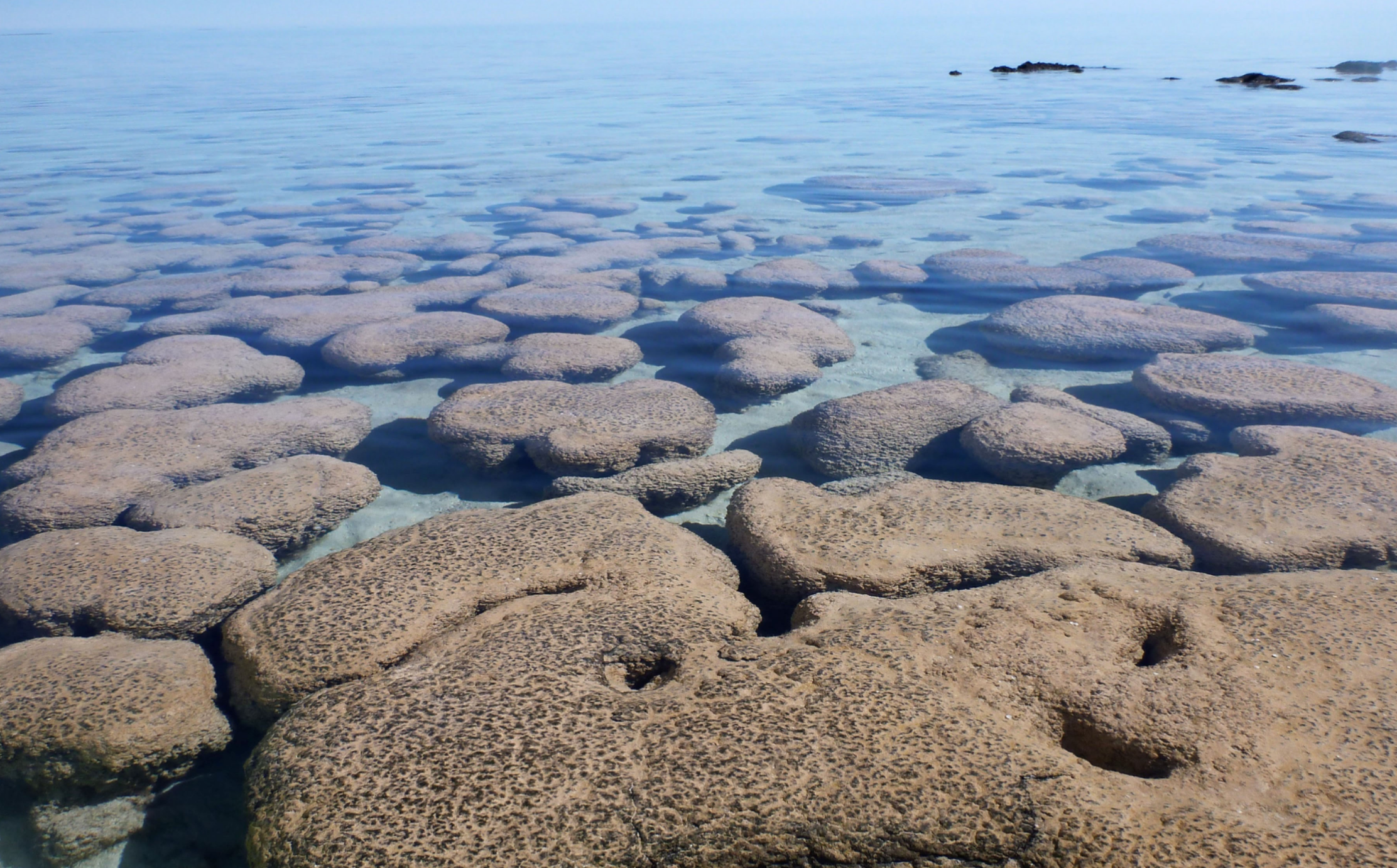 The cyanobacteria turned to be an extraordinarily enduring class of life. They are still with us today. In the warm tropical waters of the intertidal zone at Shark Bay in Western Australia, thin films of a species of cyanobacteria cement sand to form layered, dome-shaped mounds known as stromatolites. Fossil stromatolite structures go back almost 2.5 billion years.
The greater part of the energy driving photosynthesis is stored by plants (and animals, which live by eating plants or eating animals that eat plants) in the chemical bonds of their organic compounds. Excepting only nuclear energy, photosynthesis is the most efficient energy collection and storage system that we know.
Between 2.4Ga and 1.8Ga, evolution of the eukaryotic cell (cells whose DNA is concentrated in a nucleus) and multicellular life forms made photosynthesis more efficient and plant life more diverse, abundant and widespread in the photic (sunlight penetrating) zone of surface waters. We call them phytoplankton. As a result, ever more carbon dioxide was consumed, ever more oxygen was released back to the atmosphere. An initial slow increase in atmospheric oxygen became, from around 2.4Ga, a step increase. This was by far the most important change in the evolution of the earth’s atmosphere. It is known as the Great Oxidation Event (GOE) – if a process lasting several hundred million years can be called an “event”.
Today, our atmosphere contains, by volume, around 21% oxygen and 79% nitrogen. A mere trace of carbon dioxide remains, making up 0.0043% or 430 parts per million. Methane is even more trace at 1.3 parts per billion. Sulphuric Acid is less than 1 part per trillion.
High levels of free oxygen in the earth’s atmosphere are the product of photosynthetic life. No other planet in the galaxy that we know of contains free oxygen. If we ever discover such a planet, the presence of extraterrestrial life would be a plausible explanation.
The reverse process to photosynthesis is called respiration. In respiration, living things power their activities by burning a small proportion of their carbohydrate in oxygen, thus releasing some of their stored carbon back to the atmosphere as CO2. On the death of water-living plants (phytoplankton), the bulk of their carbon (estimated at around 90%) settles to the sea floor to accumulate as organic-rich deposits. There, sealed from oxygen by water depth and co-deposited silt, this transformed overtime through pressure and temperature into oil and gas.
Life Conquers the Land
Land-living plants (and their dependent animals) were late comers to evolution. They first evolved around 4-500 million years ago (0.4-0.5Ga).
In terms of sheer volume of living matter, the great age of land plants occurred approximately between 0.36Ga and 0.3Ga, a time interval appropriately named the Carboniferous Period. A Period when vast forests of fern, tree fern and lycopods covered much of the low latitude areas of what was then the super continent Pangea. Their activity boosted atmospheric oxygen levels to 30-35% – a level not matched before or since. This could well be called the Second Great Oxidation Event, although, after the end of the Carboniferous, atmospheric oxygen levels reverted to pre-Carboniferous levels of around 15-20%.
Insects and arthropods have relatively inefficient respiratory systems that restrict their body size. The high oxygen levels of the Carboniferous enabled some species in these groups grow to giant size. Fossils of dragonflies with 75cm wingspans and 2.5m-long millipedes weighing up to 50kg have been found in Carboniferous strata.
During the Carboniferous, wildfires were impressive and frequent, as fossilised charcoal layers in the stratigraphic column attest.
Accompanying the rise in free oxygen, atmospheric CO2 levels during the Carboniferous fell as the carbon extracted by plants from the atmosphere was sequestered in rapidly accumulating tropical lowland and delta swamps. The Carboniferous period eventually came to an end when low atmospheric CO2 levels eventually put a brake on photosynthetic activity. The fossilised remains of the Carboniferous forests now provide a major source of our high-grade black coal deposits.
The Effect of the GOE on Iron
Iron is a heavy element (atomic number 26) that arrived in the early accreting days of the earth through continuous meteor impact. Today, iron is the most abundant element by weight in the planet, but most of it lies in the inner molten core. In the crust iron is the 4th most abundant element. In basaltic rocks, iron constitutes 10-15%. The early crust of the earth was dominated by rocks of basaltic composition.
Iron comes in two flavours called valency states: ferrous iron, written Fe 2+ and ferric iron written Fe 3+. The metal thus has great capacity for combining with elements of negative charge, particularly oxygen, ever hungry for a positively-charged valency partner. If only a small amount of oxygen is available to it, iron forms low-oxidation ferrous oxide compounds. Where there is abundant oxygen available, it forms high-oxidation ferric oxide compounds.
But note, there is an important distinction between the two states of iron. Ferrous iron compounds are generally soluble in water: ferric iron compounds are not.
In the low oxygen reducing atmosphere of the first 2-2.5 billion years of earth history, chemical erosion of basaltic rocks at surface produced soluble ferrous iron oxide compounds, which, washed by rivers to the sea, slowly accumulated in the oceans of the world: trillions of tons of dissolved iron. During the GOE, between 2.5Ga and 1.8Ga (the late Archaean to the Early Proterozoic) the oceanic reservoir of ferrous iron became oxygenated to ferric iron which, being insoluble, settled as a chemical sediment of ferric iron oxide (Fe2O3) on the sea floor to form thick sequences of great thickness and lateral extent. These sequences are typically banded at centimeter scale (a texture known as varves) by silica in the form of chert layers. This indicates control by a fine scale, regular cycling of depositional conditions, probably reflecting seasonal conditions. These distinctive rocks are known as Banded Iron Formations or BIFs.
Banded Iron Formations are preserved today sitting unconformably upon upon all the ancient Archaean shield areas of the world in Western Australia, Brazil, Venezuela, the NE of North America, India, West and South Africa and parts of eastern Asia.
The theory that the deposition of the BIFs was caused by the GOE is now widely accepted. The theory was first formulated by geophysicist P.E (Preston) Cloud in a paper in Science in 1969 (2) and further expanded by him in an Economic Geology paper in 1973 (3).

Banded Iron Formation exposed in the Karinjini Gorge, Hamersley Range, Western Australia. Image: WA Tourist Department.
But another process was at play during the GOE
Plants and animals need oxygen to respire, to live. But that life is the result of a Faustian Contract made around 3 billion years ago. Free oxygen is highly corrosive. In living bodies reactive oxidising compounds are known as free radicals and are highly dangerous. The accumulation of copying errors in DNA that occurs with age is the result of oxidation and puts strict limits on the individual life span of all living things, including us.
For rocks exposed at surface, free oxygen breaks down the minerals in contact with it. The GOE supercharged chemical erosion of all exposed land surfaces especially as, back then, there were no land plants to bind soils and constrain river channels. Beginning around 2.5 Ga, increasing floods of clastic sediment poured off the land creating, for the first time at volume, wide sedimentary shelves and shallow marginal seas around the great continental land masses. At the base of these sequences, interspersed with silica and aluminium rich clastic sediment, are the Banded Iron Formations.
Every wildfire is a demonstration of out-of-control oxidation. Every chemical explosion is a demonstration of a near instantaneous chain reaction oxidative event.
For these reasons, some have referred to the Great Oxidation Event as the Great Oxygen Catastrophe.
The Economic Importance of Banded Iron Formations
Iron is our cheapest and most useful metal. We first learnt how to smelt it from its oxide ores around 2500 years ago, thus initiating the Iron Age and, because iron is so much stronger and harder than bronze, supplanting the previous Bronze Age. Another factor in this transition was that ore suitable for iron smelting was readily available whereas copper and tin ores (especially tin) needed to make bronze are geographically restricted throughout Europe and the Middle East.
BIFs contain, in bulk, around 30% iron by weight. Natural processes operating over time, have locally upgraded them to 60-65% iron – almost pure iron oxide (Fe2O3). These high-grade zones are today extracted in vast open cut mines, producing the ore from which today 95% of our iron is smelted. Around the world, ship-borne high-grade BIF ore has now almost totally supplanted the local low-grade deposits that supplied early Iron Age societies.
Four point eight billion tons of iron ore were mined in 2025. The four biggest producers are Australia (980mt), Brazil (410mt), China (340mt) and India (125mt).
Abundant iron in the form of its various alloys (especially steel), builds the skeletal frameworks that support our civilisation. From bridges to buildings, ships to railroads, automobiles to trucks to turbines to tanks, we owe our supply of cheap ore to the Great Oxidation Event, and to the fossil remains of plant material with which we reduce it to iron.
But will this Bonanza Last?
Nothing is forever. No resource is inexhaustible. However, although extraction of 4.8 billion tons of iron ore per annum seems a large number, it is trivial compared to what is potentially available from the Banded Iron Formations of the world.
There is no prospect of the ore running out within this millennium.
******
(1) J.A. Steadman (plus 10 co-authors): Evidence for variable and elevated atmospheric oxygen in the Precambrian. Precambrian Research, July 2020. https://doi.org/10.1016/j.precamres.2020.105722
(2) Preston Coud: Atmospheric and Hydrospheric Evolution on the Primitive Earth. Science, 1968, v160, pp 729-736.
(3) Preston Cloud: Palaeoecological significance of the Banded Iron Formations. Economic Geology 1973:68(7): 1135-1143.